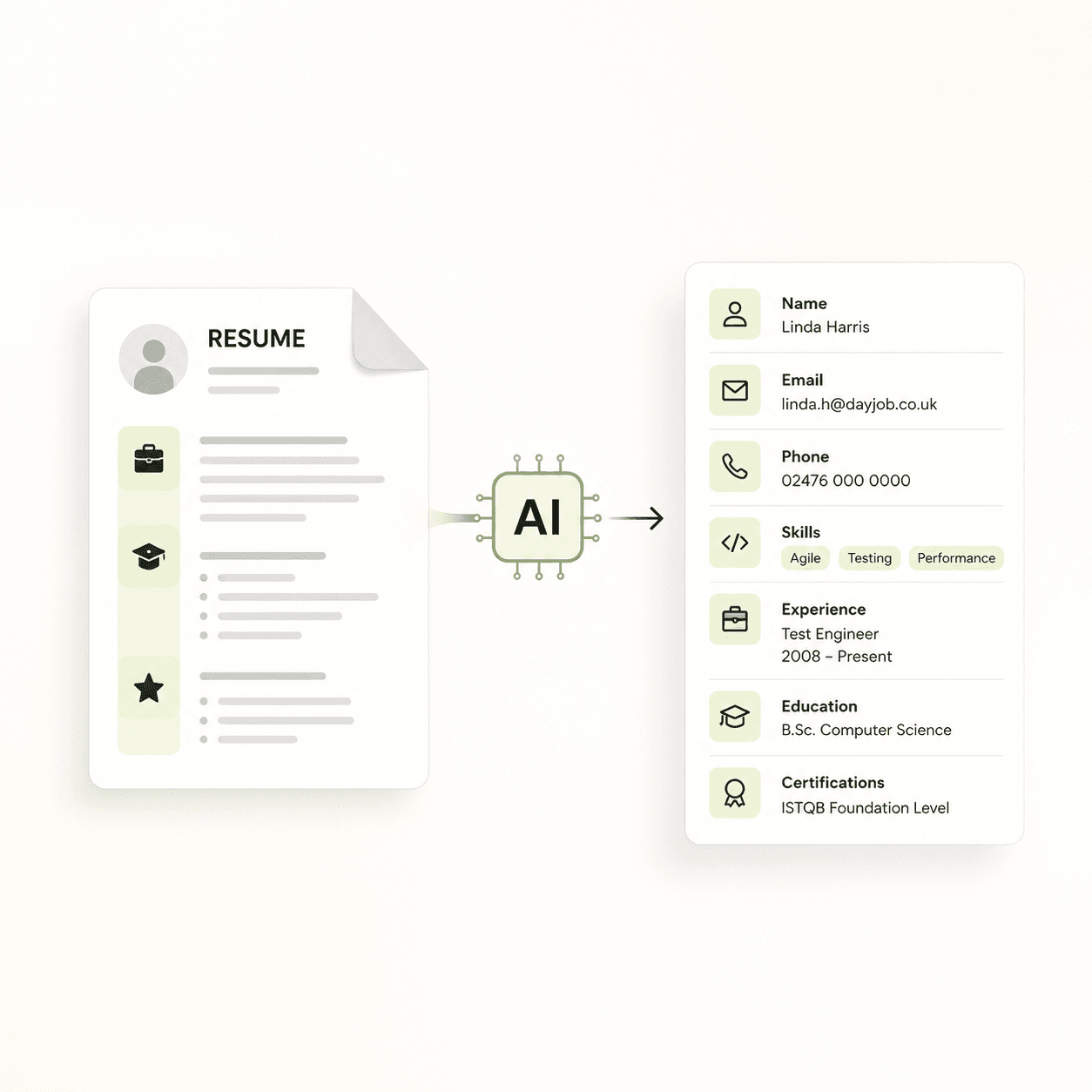
A recruiter uploads 400 PDF resumes into your app on a Monday morning. Every one has a different layout, different fonts, and half of them are scans. Someone still has to pull out the name, the email, the skills, and the last three jobs so your database can actually search them.
Doing that by hand is a slow, expensive mess. A resume data api does it in seconds. You send the file, it sends back clean structured JSON. In this guide we compare 7 of the best options for 2026, with verified pricing and real use cases.
Here are the 7 resume data APIs we cover:
- SharpAPI AI Resume Parsing API
- APILayer Resume Parser API
- ResumeParserAPI.com
- Affinda Resume Parser API
- RChilli Resume Parser
- Textkernel Resume Parser (Sovren)
- Quick-Extract Resume Parser
Resume Data API: Why You Need One
Resume data API turns PDFs into fields
A resume is built for a human to read, not for your code to parse. The name sits in a header, the dates hide in a sidebar, and the skills are scattered across three sections. Your app can't do anything useful with that until it becomes structured data.
That is the whole job of a resume parser api. You hand it a PDF or a Word file, and it returns clean JSON: name, email, phone, skills, work history, and education, each in its own field. Now you can search it, rank it, and store it.
People try to skip the API and write their own parser with regex and a few rules. It works on ten neat resumes. Then a two-column layout shows up, or a scanned photo of a printed CV, and the whole thing falls apart. A good parser handles those cases so you don't spend your quarter patching edge cases.
What to look for in a resume parser api
Not every parser fits every job. Before you pick one, check these six things:
- Accuracy: how clean is the output on messy, real-world resumes, not just tidy samples? This is the number that decides how much manual cleanup you still do.
- Language coverage: the options here range from about 12 languages to 40 or more. Match that to who actually applies to your jobs.
- File formats: PDF and DOCX are table stakes. If you get scans or phone photos, you need a parser that reads images too.
- Sync vs async: some APIs answer in one call, others give you a job ID to poll. Async is better for big files and bulk loads.
- Pricing model: per request, per page, per credit, or flat monthly. The same workload can cost wildly different amounts across providers.
- Data privacy: resumes are full of personal data. Look for GDPR handling and a clear policy on how long files are stored.
Top 7 Resume Data APIs of 2026
We put this list together after digging through the docs, the pricing pages, and the actual request and response of each provider. Marketplace APIs, dedicated parsers, and enterprise engines all made the cut. The featured pick sits first, then the rest in no strict order.
1. SharpAPI AI Resume Parsing API
The SharpAPI AI Resume Parsing API on API.market takes a resume or CV and returns a deep, structured breakdown of the candidate. You upload the file, the API runs the parse as a background job, and you poll a status URL to grab the result. One API key on the marketplace covers it, so you skip juggling separate accounts.
What makes this one worth putting first is how much it pulls out. You don't just get name and email. You get a full positions array where every job carries its own skills list, dates, and a written summary of what the person did. That is the kind of detail that makes matching and ranking actually work.
Key Features
- Extracts candidate name, email, phone, address, and spoken languages in one call
- Returns a full work-history array with per-role skills, dates, and job descriptions
- Pulls education, certifications, and honors into their own clean fields
- Async job model that handles large files without timing out
- Optional language parameter for better accuracy on non-English CVs
- Lives on API.market, so one key and one billing account covers everything
Here is what a real request looks like. You post the file and get back a job ID:
curl -X 'POST' \
'https://api.magicapi.dev/api/v1/sharpapi.com/resume/api/v1/hr/parse_resume' \
-H 'accept: application/json' \
-H 'x-api-market-key: YOUR_API_KEY' \
-H 'Content-Type: multipart/form-data' \
-F 'file=@Your_Resume.pdf;type=application/pdf' \
-F 'language=English'
Then you poll the status URL, and the finished result comes back like this:
{
"candidate_name": "Linda Harris",
"candidate_email": "[email protected]",
"candidate_phone": "02476 000 0000",
"candidate_spoken_languages": ["German"],
"positions": [
{
"position_name": "Test Engineer",
"company_name": "IT & Telecoms Company",
"start_date": "2008-06-01",
"skills": ["Acceptance testing", "Agile", "Performance testing"]
}
]
}
Notice the skills sit inside each position, not in one big blob. When you build a search that asks "who did Agile testing after 2008," that structure is what makes the query easy.
Pricing
You start free with 25 calls per month, no card needed. Paid plans begin at $20 per month, and you can see the full plan lineup on the API.market listing before you subscribe. For most small teams, the free tier is enough to test a real batch of resumes before you spend anything.
Real Use Cases
- Say you run a job board and you want candidates to apply in one click. A user uploads their CV, you call the parse endpoint, and by the time they reach the next screen the form is already filled in. Their name, email, and last job are sitting there waiting. Fewer fields to type means more people finish the application.
- Now picture an internal recruiting tool that ranks applicants. You parse every incoming resume, store the positions array, and score candidates on the skills tied to their most recent role. Because SharpAPI keeps skills attached to each job, you can weight recent experience higher than something from ten years ago. That is hard to do when skills come back as one flat list.
2. APILayer Resume Parser API
APILayer's Resume Parser API is an NLP-based service that turns any PDF or Word resume into JSON. It works from a public URL or a direct file upload, and it was trained on more than 26,000 school names and 70,000 skills, so it recognizes the common stuff well.
Key Features
- Parses from a resume URL or a direct file upload
- Extracts name, email, skills, education, and experience
- Trained on 26,000+ institution names and 70,000+ skills
- Tested for English, with usable results in about 12 more languages
- Deletes uploaded files after 15 seconds and stores nothing, GDPR-friendly
Pricing
The Free plan gives you 100 requests per month for life with no credit card. After that, the Starter plan is $29.99 per month for 1,500 requests, and the Pro plan is $49.99 per month for 4,500 requests. High volume runs on a custom quote.
Real Use Cases
- Imagine a small ATS serving a handful of staffing clients. You process a few thousand resumes a month, and you care more about a predictable bill than fancy extras. The Starter tier at $29.99 covers that cleanly, and the 15-second file deletion is an easy line to put in your privacy policy.
- Or think about a side project that scores resumes against a job post. The free 100 requests a month let you build and demo the whole thing without paying, which is a nice place to start before you know if the idea has legs.
3. ResumeParserAPI.com
ResumeParserAPI.com runs on RapidAPI and focuses on one thing: fast, accurate extraction with wide format support. It reads PDF, DOCX, RTF, TXT, and HTML, claims 95%+ accuracy, and pulls 50+ data points from a single call.
Key Features
- Handles PDF, DOCX, DOC, RTF, TXT, and HTML resumes
- Extracts 50+ data points including skills, certifications, and projects
- Claims 95%+ accuracy across structured fields
- Supports 30+ languages with automatic language detection
- AES-256 encryption, GDPR and CCPA compliant, SOC 2 on Enterprise
Pricing
The Basic plan is free with 10 requests per day. The Ultra plan is $59 per month for 1,000 requests plus $0.12 per extra request, and the Mega plan is $350 per month for 10,000 requests plus $0.095 per extra request with a bulk API. A 40% launch discount shows up on the site sometimes, so check the price before you buy.
Real Use Cases
- Say your users upload resumes in every format under the sun, including old RTF files and HTML exports. This API takes all of them without you writing converters, which saves a real chunk of engineering time.
- Picture a growing HR platform that started tiny and now parses thousands of resumes a week. You begin on the free daily tier while you build, move to Ultra when real traffic shows up, and jump to Mega with its bulk endpoint once you are processing at scale. The tiers grow with you.
4. Affinda Resume Parser API
Affinda is a document-intelligence company, and resume parsing is one of its strongest products. It reads a wide range of layouts across many languages with 95%+ accuracy on the key fields. You can start online with pay-as-you-go, no sales call needed.
Key Features
- High parsing accuracy across diverse and messy resume layouts
- Multilingual parsing for international hiring
- Part of a broader document platform, so it scales past resumes
- Clean REST API with solid documentation
- Self-serve signup, plus annual plans that drop the per-document price at volume
Pricing
Affinda's Resume Parser runs on pay-as-you-go at US$0.20 per page with no annual commitment, and your first 14 days include 200 free pages. If you need volume, annual subscriptions start at US$3,600 per year for 66,000 documents, and the price per document drops as you scale up. Overage is charged at your committed per-document rate.
Real Use Cases
- Think about an HR product that needs accurate parsing but does not want to sign a big contract on day one. You start pay-as-you-go at $0.20 a page, run your real resumes through the free 200-page trial first, and only move to an annual plan once you know your volume.
- Or picture a company processing steady, high volume every month. At 66,000 documents a year the annual plan works out cheaper per document than pay-as-you-go, and the per-document rate keeps dropping as your numbers climb.
5. RChilli Resume Parser
RChilli is one of the most established names in resume parsing. It runs at serious scale, parsing over 4.1 billion documents a year for 1,600+ recruiting platforms, and it plugs straight into the big enterprise systems like Oracle HCM, SAP SuccessFactors, and Salesforce.
Key Features
- Parses resumes and CVs in 40+ languages
- Skill taxonomy and data enrichment for cleaner, standardized output
- Redacts 57+ fields to support bias-free hiring
- Native integrations with Oracle, SAP, Salesforce, and ServiceNow
- SOC 2, HIPAA, and ISO certified, plus FedRAMP Ready
Pricing
RChilli uses custom pricing, so you talk to their team for a quote based on your volume and integration. A free trial is available so you can test the parser first. This one is aimed at enterprise HR stacks rather than solo builders.
Real Use Cases
- Say you run recruiting for a large company already living inside Oracle HCM or SAP SuccessFactors. RChilli drops in as a native integration, so candidate data flows into the system you already use without a custom build. Their team says setup can take as little as 15 minutes.
- Now think about a regulated employer that needs unbiased screening. The redaction feature strips out 57+ fields like name and gender before a human sees the resume, which supports fairer first-round reviews and gives your compliance team something concrete to point at.
6. Textkernel Resume Parser (Sovren)
Textkernel runs the parsing engine that used to be called Sovren, and it has been in this market for over two decades. It does more than parse: it also matches and searches, which is why so many enterprise ATS platforms quietly run on it under the hood.
Key Features
- Mature parser with 95%+ accuracy on the most critical fields
- Built-in job matching and semantic candidate search
- Optional LLM Parser that cuts remaining errors further
- Parses in-memory and stores no resumes, plus skills and profession taxonomies
- Developer console where you create your own API credentials
Pricing
Textkernel runs on credits that you buy in advance, and a monthly subscription tops them up automatically so you don't run out mid-month. You can sign up for a free trial and test through the UI or the API before you commit. Exact rates depend on your volume, so you get a quote from their team for production pricing.
Real Use Cases
- Picture a staffing firm that wants to parse a resume and immediately match it against open roles. Textkernel does both in the same platform, so you skip bolting a separate matching engine onto your parser.
- Or think about an ATS vendor building search into their product. Candidates get parsed on intake, and recruiters run semantic searches like "senior React developer in Berlin" against the whole database. The matching layer is what makes that feel smart instead of a plain keyword lookup.
7. Quick-Extract Resume Parser
Quick-Extract takes a pay-as-you-go approach. There is no monthly plan to commit to. You pay per page, you get clean JSON back in a few seconds, and it reads images as well as PDFs, which helps a lot with scanned resumes.
Key Features
- Reads PDF, PNG, and JPG, including scans and phone photos
- 99.5% text recognition accuracy with smart section detection
- Returns results in 3 to 5 seconds per resume
- Supports 50+ languages with automatic detection
- Simple REST API that returns structured JSON
Pricing
Quick-Extract charges $0.05 per page with no monthly fee and no minimum. A one-page resume costs a nickel, a two-page resume costs a dime. New accounts get $5 in free credits to test, which is enough for roughly 100 pages.
Real Use Cases
- Say your resume volume is spiky. Some months you parse 50 resumes, some months 5,000. A flat monthly plan either wastes money or caps you out. Paying $0.05 a page means your bill tracks your actual usage, which is friendly for seasonal hiring.
- Now picture a workflow where half your resumes arrive as scanned images or photos taken on a phone. Parsers that only read text-based PDFs choke on those. Because Quick-Extract reads images directly, you feed it the scan and still get structured data out.
Resume Data API Pricing Overview
Here is the quick money view, one line per API, so you can match a plan to your budget:
- SharpAPI: free tier with 25 calls per month, paid plans from $20 per month.
- APILayer: free 100 requests per month for life, then $29.99 per month for 1,500 requests.
- ResumeParserAPI.com: free Basic at 10 requests per day, Ultra $59 per month, Mega $350 per month.
- Affinda: pay-as-you-go at US$0.20 per page, free 14-day trial with 200 pages, annual from US$3,600 per year.
- RChilli: custom enterprise pricing with a free trial to test first.
- Textkernel: free trial available, then credit-based pricing you buy in advance, quote on request.
- Quick-Extract: pay-as-you-go at $0.05 per page, $5 in free credits to start.
Conclusion
Every API on this list turns messy resumes into clean data, but they fit different teams. If you run a huge enterprise HR stack on Oracle or SAP, RChilli or Textkernel earn their price with native integrations and matching.
If your volume is low or spiky, Quick-Extract's $0.05 a page keeps the bill honest. If you want strong accuracy with self-serve pay-as-you-go, Affinda holds up.
For most teams building something new, we would start with the SharpAPI AI Resume Parsing API on API.market. You get deep structured output, with skills tied to each job instead of one flat list, a free tier of 25 calls to test a real batch, and paid plans from $20 per month. One marketplace key covers your billing, and the async job model handles big files without breaking. It is the resume data api we would hand a new project first, then scale up from there if your needs grow.
FAQs about Resume Data APIs
Q1: What is a resume data API?
A resume data API is a service that takes a resume or CV file and returns structured data as JSON. You upload a PDF or Word document, and the API extracts fields like name, contact details, skills, work history, and education. It replaces manual data entry, so your app can search, rank, and store candidate information automatically at scale.
Q 2: How accurate is a resume parser api?
Accuracy usually runs between 90% and 99%, depending on the provider, the file quality, and the language. Clean, text-based PDFs in English score highest. Scanned images, two-column layouts, and creative designs are the hard cases, so test any parser with your messiest real resumes before you commit to it.
Q 3: Is there a free resume data api?
Yes, several offer a free tier. SharpAPI gives you 25 calls per month, APILayer gives 100 requests per month for life, and ResumeParserAPI.com allows 10 requests per day. Quick-Extract includes $5 in free credits, and Affinda gives a 14-day trial with 200 free pages. These are enough to test a real batch before paying.