You open the official IMDb developer page, find the API, and then see the pricing. $150,000 minimum, plus metered charges, for data you just need to power a simple movie search. That is not a typo.
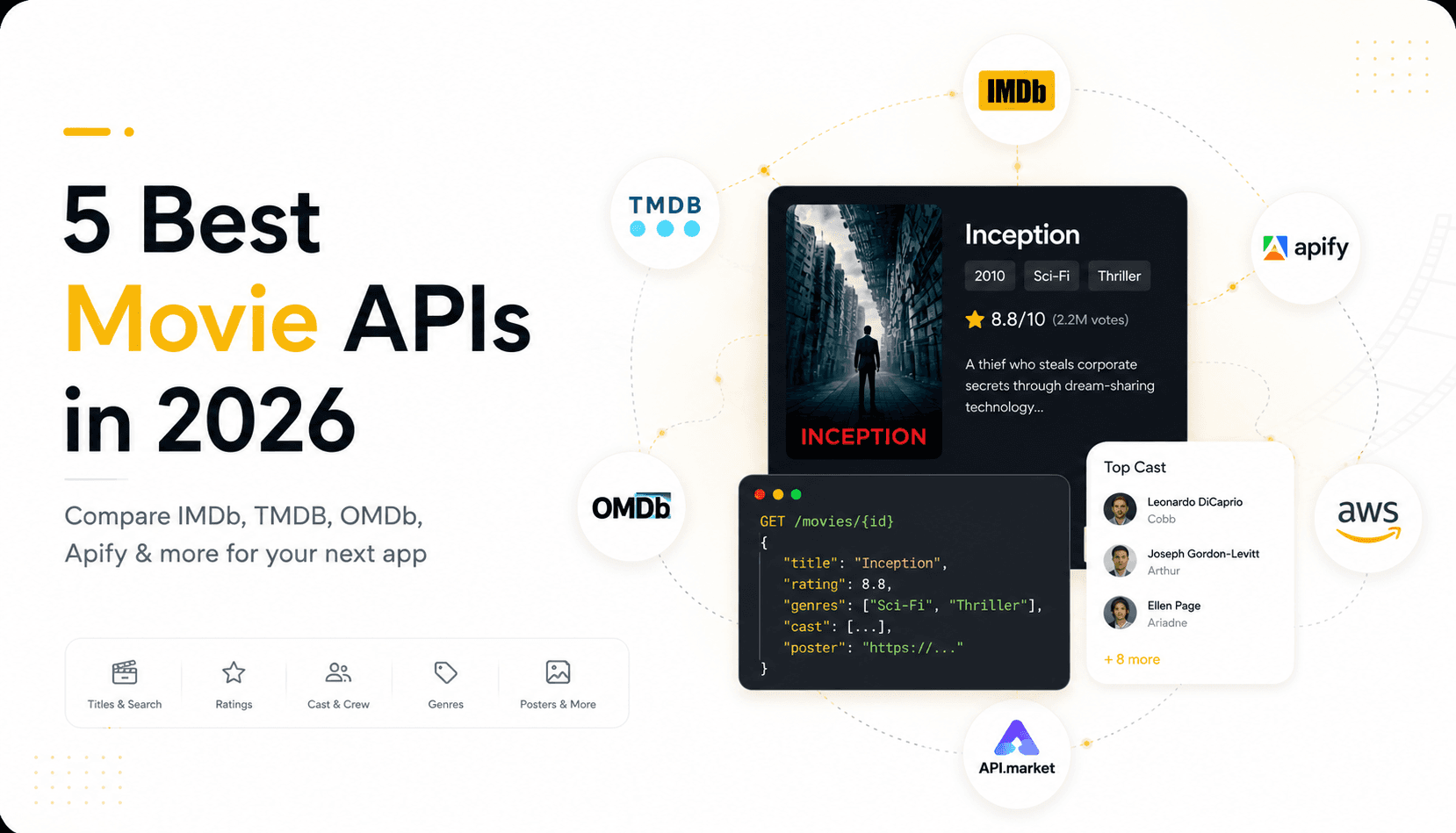
For most developers, the official IMDb API is completely off the table. This guide covers the five best movie APIs in 2026: what they actually cost, what they return, and which one fits your project.
Here are the five movie APIs we are covering:
- IMDb API on API.market
- TMDB (The Movie Database)
- OMDb API (Open Movie Database)
- Apify IMDb API
- Official IMDb API (AWS Data Exchange)
Movie APIs: What You Actually Need to Know First
What a Movie API Gives Your App
A movie API gives your application access to structured entertainment data without building anything from scratch. Instead of scraping, you make one API call and get back titles, ratings, genres, cast and crew, posters, release years, and plot summaries in a clean JSON response.
You can build a lot with that. Movie recommendation engines, streaming platform directories, watchlist tools, entertainment news aggregators, content management systems for media companies - these all run on movie API data. The cleaner the source, the less time you spend fighting data pipelines.
You can use a movie database API to:
- Power search and filter functionality for entertainment apps
- Build personalized recommendation systems based on genre, rating, and cast
- Pull metadata for media library management at scale
- Run competitive analysis on box office trends and ratings
- Feed data into research and journalism workflows
Why the Official IMDb API Does Not Work for Most Teams
Let me say this directly: the official IMDb API runs through AWS Data Exchange and starts at roughly $150,000 per year. It is built on GraphQL, not REST, which adds real integration complexity. And the commercial terms restrict what you can build with the data.
That is why if you search Reddit for "best IMDB API for a movie app," you get a whole thread of developers in the same situation.
The obvious answer does not work for most of them. The good news is that there are solid alternatives, and a couple will surprise you on price.
The 5 Best Movie APIs in 2026
1. IMDb API on API.market
If you need IMDb-quality movie and TV data through a clean, well-documented REST API without negotiating an enterprise contract, this is where to start.
The IMDb API on API.market gives you access to a rich dataset: titles, actor profiles, ratings, cast and crew details, genre metadata, posters, and advanced search filters. You can filter by language, country, awards, minimum rating, keywords, and title type. The API covers 15 endpoints and uses asynchronous processing to handle larger requests efficiently.
Setup takes a few minutes. You authenticate by passing your key in the request header as x-api-market-key. From there you have two main workflows: quick lookups using the genre and title type endpoints, and richer queries using the advanced search. An OpenAPI spec ships with the API so you can import it straight into Postman or Insomnia and explore every endpoint before writing a line of code.
The asynchronous architecture is worth understanding because it affects how you design your integration. When you fire a search request, the API returns a prediction ID immediately. You then poll the status endpoint (GET /api/v1/magicapi/imdb/predictions/{id}) until the status comes back as succeeded or failed. Poll every second with a maximum timeout of 600 seconds. Status check calls are completely free and do not count against your API units.
Here is what a basic advanced search call looks like:
curl -X GET \
  "https://prod.api.market/api/v1/magicapi/imdb/search/advanced?query=batman&limit=2&types=movie" \
  -H "x-api-market-key: YOUR_API_MARKET_KEY"
The response comes back with a titles array, each entry containing the IMDb ID, primary title, primary image URL with dimensions, and pagination metadata. You can push up to 100 results per call and sort by POPULARITY or USER_RATING in ascending or descending order.
Key Features:
- Advanced search and filtering by genre, rating, language, country, awards, and keywords
- Returns titles, actors, ratings, cast and crew, posters, and more in structured JSON
- Asynchronous processing with prediction ID polling for handling large requests
- OpenAPI specification included for seamless tool integration
- Covers movies, TV series, shorts, and other title types across 15 endpoints
- Sort results by popularity or user rating in either direction
- Soft rate limit model: you keep running past your plan limit and pay overage rather than getting hard-blocked
Pricing:
The free trial gives you 100 API units over 7 days with no credit card required. After the trial, the Start plan is $5/month for 10,000 API units, with extra usage billed at $0.0001 per unit. The Pro plan is $10/month for 100,000 units, with extra usage at $0.00005 per unit. One API unit equals one search request. Status check calls on prediction IDs are free and never count toward your usage.
Real Use Cases:
Say you are building a movie discovery app. Users set a minimum rating, pick a genre, and expect a curated list back. You call the advanced search endpoint with genres=Thriller&imdbRatingMin=7.5&sortBy=POPULARITY and get back a ranked list with titles, ratings, and poster URLs in one response. No scraping, no brittle HTML parsing, no enterprise contract.
Or you run a monthly report on box office and ratings trends. You pull title metadata for the last quarter, filter by release year and genre, and push it into a visualization tool. That workflow takes a few minutes of scripting and a cron job. Without the API, you are copying data manually across multiple sources.
Content recommendation systems are another strong fit. You store a user's watch history, call the API for genre and cast metadata on each title, and use that data to weight and surface new recommendations. The response structure maps cleanly into most recommendation pipelines without heavy transformation work.
Media companies building internal tools also use this. A content operations team needs to tag and categorize hundreds of titles in their library. They run batch calls through the advanced search, pull structured metadata for each title, and auto-populate their CMS. What used to take a team a week runs overnight.
2. TMDB (The Movie Database)
TMDB is the most widely used free movie database with a public API. It is community-driven, actively maintained, and covers over one million movies, TV shows, and celebrities.
For non-commercial projects, TMDB is one of the strongest free options out there. The documentation is thorough, the API returns a wide range of data, and a full OpenAPI v3.1 spec is available so you can explore the schema before you commit to anything. The rate limit sits at roughly 40 requests per second at the IP level, not tied to an API key, which means well-behaved applications rarely hit it.
What makes TMDB particularly strong is the breadth of what a single API call returns. You can get movie details, cast and crew, genres, spoken languages, production companies, release dates by country, trailers and videos, user ratings, popularity scores, and full image sets including multiple poster and backdrop sizes. It also has dedicated endpoints for trending content, similar movies, recommendations, and now-playing lists, which saves you from building that logic yourself.
Accessing TMDB is straightforward. You register for an API key at themoviedb.org, pass it as a query parameter or bearer token, and start pulling data on version 3 of the REST API. Version 4 is available too and adds some newer features, but v3 is still the stable standard most developers use.
The commercial tier is where the calculus changes. The moment you monetize your app, add ads, or charge users, you need a commercial license. TMDB sets that at $149/month for companies under $1 million in annual revenue. If you cross that threshold, you contact their sales team and negotiate. There is no published pricing above the $149 mark, which makes forward budgeting difficult for fast-growing products.
Key Features:
- Over 1 million movies and TV shows with community-maintained, high-quality metadata
- Detailed per-title data: cast, crew, genres, languages, production companies, release dates, and more
- Trending, now-playing, popular, and top-rated endpoint collections built in
- High-quality posters, backdrops, and image sets in multiple sizes
- OpenAPI v3.1 specification for easy integration and exploration
- Multiple language and locale support for international apps
- Rate limit of roughly 40 requests per second, IP-based rather than API key-based
Pricing:
TMDB is free for non-commercial use with required attribution. The commercial license is $149/month for companies with under $1 million in annual revenue. Above that, pricing is custom and negotiated directly with the TMDB team.
Real Use Cases:
A developer building a personal movie tracker, an open-source watchlist tool, or a university film studies research platform will find the free tier covers everything. The data quality is high and the community keeps it current across titles, cast data, and images.
For a startup building an entertainment app with a small but growing user base, the $149/month commercial plan is workable. You get access to the full API, you can attribute TMDB in your UI, and you keep shipping. The friction comes when your revenue crosses $1 million and you enter custom pricing territory with no clarity on what comes next.
Developers building recommendation features specifically tend to get a lot of value from TMDB's similar movies and recommendations endpoints. Instead of building a similarity model from scratch, you call those endpoints and get a pre-computed list of related titles. For many apps, that is all you need.
3. OMDb API (Open Movie Database)
OMDb is a one-person operation built and maintained by developer Brian Fritz. It has been around for years, setup takes about five minutes, and it focuses almost entirely on movies.
You search by title, IMDb ID, year, or type. You get back plot, runtime, director, lead cast, ratings from IMDb, Rotten Tomatoes, and Metacritic, plus a poster URL. That multi-source ratings combination in a single call is genuinely useful for anyone building a review or rating display. Instead of calling three different APIs and stitching the data together, OMDb handles it in one request.
The response is intentionally minimal and readable. A typical movie call comes back with: Title, Year, Rated, Released, Runtime, Genre, Director, Writer, Actors, Plot, Language, Country, Awards, Poster, Ratings (array with IMDb, Rotten Tomatoes, Metacritic), imdbRating, imdbVotes, imdbID, and Type. That is most of what you need for a movie detail page, without any transformation work.
Two hard limits define who this API is for. First, the CC BY-NC 4.0 license: you cannot use OMDb data in any commercial application. Not with ads, not with paying users, not at all. Second, TV show coverage is noticeably thinner than movie coverage. Series data exists, but if TV shows are a major part of your use case, you will hit gaps that frustrate users.
Poster images are also gated behind a Patreon tier rather than included in the free plan. That is not a dealbreaker for prototyping but it is worth knowing before you design a UI that relies on poster thumbnails.
Key Features:
- Search by title, IMDb ID, type (movie, series, episode), or year
- Returns plot (short or full), runtime, director, cast, awards, and poster
- Pulls IMDb, Rotten Tomatoes, and Metacritic ratings in a single response
- JSON and XML response formats
- Plot length is configurable: pass plot=short or plot=full
- 1,000 free requests per day with no setup beyond email registration
Pricing:
The free tier gives you 1,000 requests per day. Paid access comes through a Patreon subscription starting at roughly $1/month, which removes the daily request cap. The data license is CC BY-NC 4.0, so commercial use is not permitted regardless of which tier you are on. Poster image access requires a Patreon tier.
Real Use Cases:
You are building a personal movie logger to track what you have watched. OMDb covers everything you need: title, year, director, rating, and a short plot. The free tier handles the request volume easily, and the response format is so clean you can render a movie detail page without writing a single data transformation.
It also works well for quick concept validation. Before committing budget to a paid API, you use OMDb's free tier to prototype the product and prove out the data model. Once you validate the idea and know you are heading toward a commercial launch, you switch to a commercial-ready alternative.
Developers learning how APIs work also start here. The request structure is one of the simplest in this space: one endpoint, a handful of query parameters, and a flat JSON response. For teaching purposes or low-stakes personal projects, it is hard to beat.
4. Apify IMDb API
Apify's IMDb API is not a REST API in the traditional sense. I want to be upfront about that before you get excited about the pricing. It is a scraper-based Actor that crawls IMDb directly and returns structured data. You give it start URLs - a search query page, a title page, a genre category — and it runs a job, extracts the data, and drops it into a dataset you can download.
The output is clean. Each record comes back with url, year, genre, stars, title, rating, country, runtime, director, certificate, description, and the original IMDb URL. You can run custom output functions if you need to pull additional fields or reshape the response for your pipeline.
What makes Apify different from just scraping yourself is the infrastructure it handles for you. Built-in proxy rotation comes on every plan, including the free tier, so you do not have to manage IP blocks or retry logic. Results export to JSON, CSV, Excel, XML, and JSONL without any extra work.
And it integrates with Zapier, Make, Google Drive, and GitHub, so you can drop data directly into existing workflows.
One thing worth flagging before you build on this: scraper-based solutions have a different reliability profile than REST APIs. If IMDb updates their page structure, the scraper can break until Apify patches it. Response times vary depending on job size and queue load. You are not getting a guaranteed SLA or consistent sub-second latency. For batch data jobs, that is fine. For a production app where a user is waiting for search results, it is not the right tool.
The Python integration looks like this:
from apify_client import ApifyClient
client = ApifyClient("<YOUR_API_TOKEN>")
run_input = {
    "startUrls": [{ "url": "https://www.imdb.com/find/?q=inception" }],
    "maxItems": 50,
    "proxyConfiguration": { "useApifyProxy": True },
}
run = client.actor("dtrungtin/imdb-scraper").call(run_input=run_input)
for item in client.dataset(run["defaultDatasetId"]).iterate_items():
    print(item)
That is genuinely it. Sign up, get your token, point it at an IMDb URL, and you get structured data back in your console. No negotiating access, no GraphQL schema to learn.
Key Features:
- Crawls IMDb directly and returns structured JSON per title record
- Outputs url, title, year, rating, genre, director, cast, country, and runtime per record
- Custom output functions let you extend or reshape the default response
- Export to JSON, CSV, Excel, XML, and JSONL formats built in
- Built-in proxy rotation on all plans including free
- Supports Python, JavaScript, CLI, and MCP clients
- Integrates with Zapier, Make, Google Drive, and GitHub
Pricing:
The Free plan gives you $5 in platform credits monthly with no credit card needed. Based on compute unit pricing, pulling 1,000 movie results costs roughly $0.30, so the free credits go a reasonable distance for testing. Starter is $29/month, Scale is $199/month, and Business is $999/month. Each paid plan includes that plan's monthly amount as prepaid usage credits, plus pay-as-you-go overage after that. Credits do not roll over between billing cycles.
Real Use Cases:
Say you are building a movie recommendation model and you need a training dataset of 50,000 titles with genre, cast, rating, and country metadata.
You set up an Apify run pointed at IMDb's top charts and genre pages, set maxItems to 50,000, and let it run overnight. The output lands in a JSON file you can feed straight into your pipeline. That job would take weeks to do manually.
Data journalists reach for Apify when they need a one-time pull for a story. You need box office performance and rating data across 500 films for a decade-long genre analysis piece. You run the Actor, download the CSV, open it in your chart tool, and start writing. No ongoing API costs, no long-term contract.
Academic researchers building datasets for film studies also use this approach. You are studying how ratings correlate with awards across different countries. Apify gives you the raw structured data to do that analysis without building your own scraper from scratch.
5. Official IMDb API (AWS Data Exchange)
I am including this one so you have the full picture. The official IMDb API is real. It exists. It comes through AWS Data Exchange and it is the most comprehensive, authoritative source of IMDb data you can get. Every title, every rating, every cast credit, every episode detail - all of it, straight from the source.
It is also not a realistic option for most of you reading this.
Entry-level pricing sits at roughly $150,000 per year through AWS, with additional metered charges on top of that. Think about what that means for a startup or a solo developer building an entertainment app. That is not a budget line, that is a Series A conversation. And you are not just paying money; you are also navigating the AWS Data Exchange procurement process, which is not fast or simple if you have never done it before.
The technical side adds more friction. The official IMDb API runs on GraphQL, not REST. If your stack is REST-based and most modern stacks are - you need to learn a different query language, manage a schema, and handle a different error model. That is real engineering overhead on top of the cost.
The commercial terms are also restrictive by default. You cannot republish, redistribute, or repurpose the data in ways IMDb has not explicitly approved. For a media company building a licensed data product, those terms are negotiable. For a developer who just wants to power a search feature in their app, they are a problem.
Who does this actually make sense for? Large streaming platforms that need a fully licensed, auditable IMDb data feed for rights management. Enterprise media companies embedding IMDb data into editorial workflows. Data vendors building licensed entertainment intelligence products at scale.
If you are not in one of those categories, you do not need this API. You need a good movies API that gives you the same data at a price that makes sense for your project.
Key Features:
- Official IMDb data at the highest possible coverage and authority
- Full cast, crew, ratings, episodes, plot, genres, and metadata
- GraphQL API with a detailed schema and documentation
- Available through AWS Data Exchange with enterprise procurement
- Auditable, licensed data feed suitable for rights management workflows
- Enterprise availability and SLAs
Pricing:
Enterprise-only pricing through AWS Data Exchange. Published figures put entry-level pricing at roughly $150,000 per year with additional usage-based charges on top. No pricing is listed publicly. You contact AWS directly and negotiate from there.
Real Use Cases:
A major streaming platform needs a fully licensed IMDb data feed to power its content metadata layer across markets. Every title in its catalog needs accurate ratings, cast data, and episode information that holds up to legal scrutiny. The official API is the only option that satisfies that requirement.
A large broadcast media company builds internal production tools that pull IMDb talent profiles and title histories. Legal requires a licensed source. The official API is the right call.
An enterprise data vendor sells entertainment intelligence to broadcast clients and needs a data agreement that allows redistribution. Again, the official API is the only one that covers that use case cleanly.
For everyone else , the IMDb API on API.market gives you access to the same IMDb data starting at $5/month, with a free trial to get started today.
Movie API Pricing at a Glance
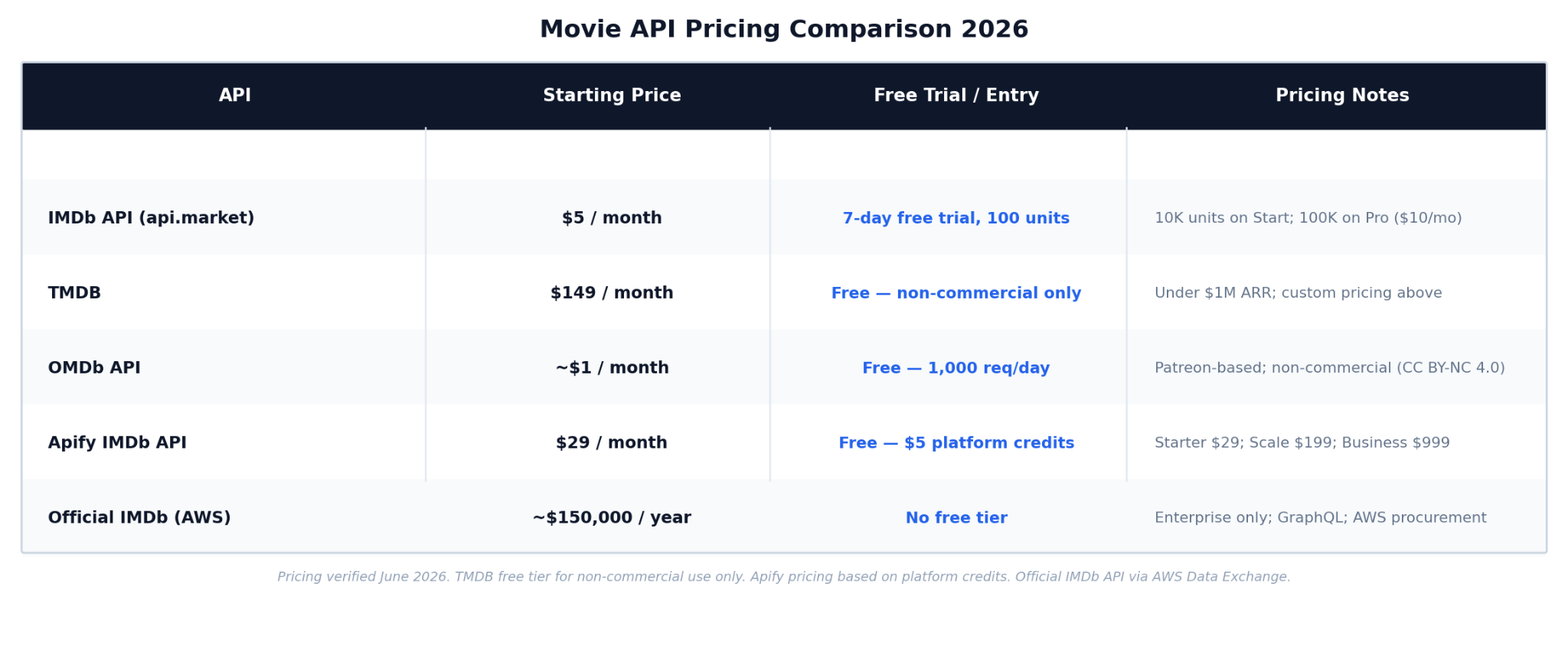
Here is a quick summary of where each option sits on pricing:
- IMDb API (API.market) - Free 7-day trial (100 units, no credit card), Start plan at $5/month for 10,000 units, Pro at $10/month for 100,000 units
- TMDB - Free for non-commercial use with attribution, $149/month commercial plan for companies under $1M ARR, custom pricing above that
- OMDb API - Free tier at 1,000 requests per day, paid from roughly $1/month via Patreon, non-commercial only (CC BY-NC 4.0)
- Apify IMDb API - Free plan ($5 platform credits/month), Starter at $29/month, Scale at $199/month, Business at $999/month
- Official IMDb API (AWS) - Enterprise only, roughly $150,000/year entry pricing, no public listing.
Which Movie API Should You Use in 2026?
For most developers, the picture is pretty clear. TMDB and OMDb work great for free, non-commercial projects. Apify handles bulk extraction jobs. The official IMDb API is an enterprise product most teams cannot access.
If you are building something commercial and need reliable, real-time IMDb data through a REST API, the IMDb API on API.market is the practical choice. You get a 7-day free trial with 100 units and no credit card required.
The Start plan covers 10,000 requests for $5/month. The Pro plan scales to 100,000 requests for $10/month. And the advanced search filters mean you spend less time fighting data and more time building.
Get started with the IMDb API on API.market
Frequently Asked Questions
Q1. Does IMDb have a free API?
The official IMDb API is not free. It is an enterprise product available through AWS Data Exchange and entry pricing sits at roughly $150,000 per year. However, the IMDb API listed on API.market offers a 7-day free trial with 100 API units and no credit card required. After the trial, paid plans start at $5/month for 10,000 units, making it the most accessible path to IMDb data for individual developers and small teams.
Q2. What is the best free movie API for developers?
TMDB is the most widely used free movie API for non-commercial projects, with over one million titles, strong documentation, and an active community. For developers who need commercial use rights and want to start without paying upfront, the IMDb API on API.market includes a free 7-day trial with no credit card, followed by plans from $5/month. That makes it the most practical option for production apps that need to stay commercially compliant.
Q3. Is the IMDB API free to use?
The official IMDb API from Amazon is not free. Entry-level pricing through AWS Data Exchange is approximately $150,000 per year. The IMDb API available on API.market is a separate, commercially accessible option with a free 7-day trial and paid plans starting at $5/month for 10,000 API units. That gives individual developers and small teams access to IMDb movie and TV data without enterprise-level costs or procurement complexity.