10 Best Real Estate APIs in 2026 (Listings, Rent Estimates, Title Data & More)

Compare the best real estate APIs in 2026: Zillow API, Rent Estimate API, Realtor Listings API, PropertyTitle API, RentCast, ATTOM, Mashvisor, AirDNA, HouseCanary, and SimplyRETS with pricing and real use cases.

Author: Aditi Upadhyay

Published: 2026-06-05T00:00:00.000Z

Updated: 2026-06-05T15:13:04.269Z

Categories:LocationGeo
Tags:Real Estate

You're building a real estate product and you need data, but the moment you start shopping for a real estate API, you hit a wall. Some want enterprise contracts.


Others are restricted to approved partners (the Zillow API is the most common example developers run into). Some cover listings but not valuations. Others cover valuations but not title risk.


This guide cuts through all of that. Here are the 10 best real estate APIs in 2026 that we'll be covering in detail, complete with verified pricing, honest breakdowns, and clear use cases for each.


  1. Rent Estimate API by TheDataClouds (API.market)
  2. Realtor Real Estate Listings API by Veer Hanuman (API.market)
  3. PropertyTitle API by NicheAPI LLC (API.market)
  4. RentCast
  5. ATTOM Data API
  6. RealEstateAPI.com (REAPI)
  7. Mashvisor
  8. AirDNA
  9. Housecanary
  10. SimplyRETS


What Is a Real Estate API and Why Do Developers Use One?


A real estate API is a data connection. You send a request, you get back structured property data in JSON format: rent estimates, active listings, title risk scores, AVM valuations, ownership history, mortgage rates, and more.


You use one because pulling that data manually is not an option at scale. A real estate API turns what would be hours of research into a single function call.


Common things you can build with a real estate data API:

  • Property search and listing platforms
  • Rent estimate calculators for tenant-facing apps
  • Title risk screening tools for acquisition workflows
  • Investment analysis dashboards comparing rental ROI
  • Lead generation systems targeting active listings
  • Mortgage affordability tools pulling live rate data


Every product in this list solves at least one of these problems. Which one you need depends on what you're building.


How to Pick the Right Real Estate API


Not every API fits every product. Before you commit to one, work through these questions:


  • What data type do you actually need? Listings, rent estimates, title intelligence, valuation models, and school data are all different endpoints, often from different providers.
  • What is your call volume? A prototype needs 50-100 calls per month. A production app could need millions.
  • Do you need a free tier? Most good APIs offer one. If they don't, find one that does so you can test before paying.
  • What is your integration timeline? Some APIs have extensive documentation and sandbox environments. Others require a sales call before you can write a single line of code.
  • Does the data need to be real-time? Active listings go stale fast. Title records and tax data do not change daily. Pick accordingly.


With those answers in hand, here are the top 10 real estate APIs available in 2026.


The 10 Best Real Estate APIs in 2026


1. Rent Estimate API by TheDataClouds


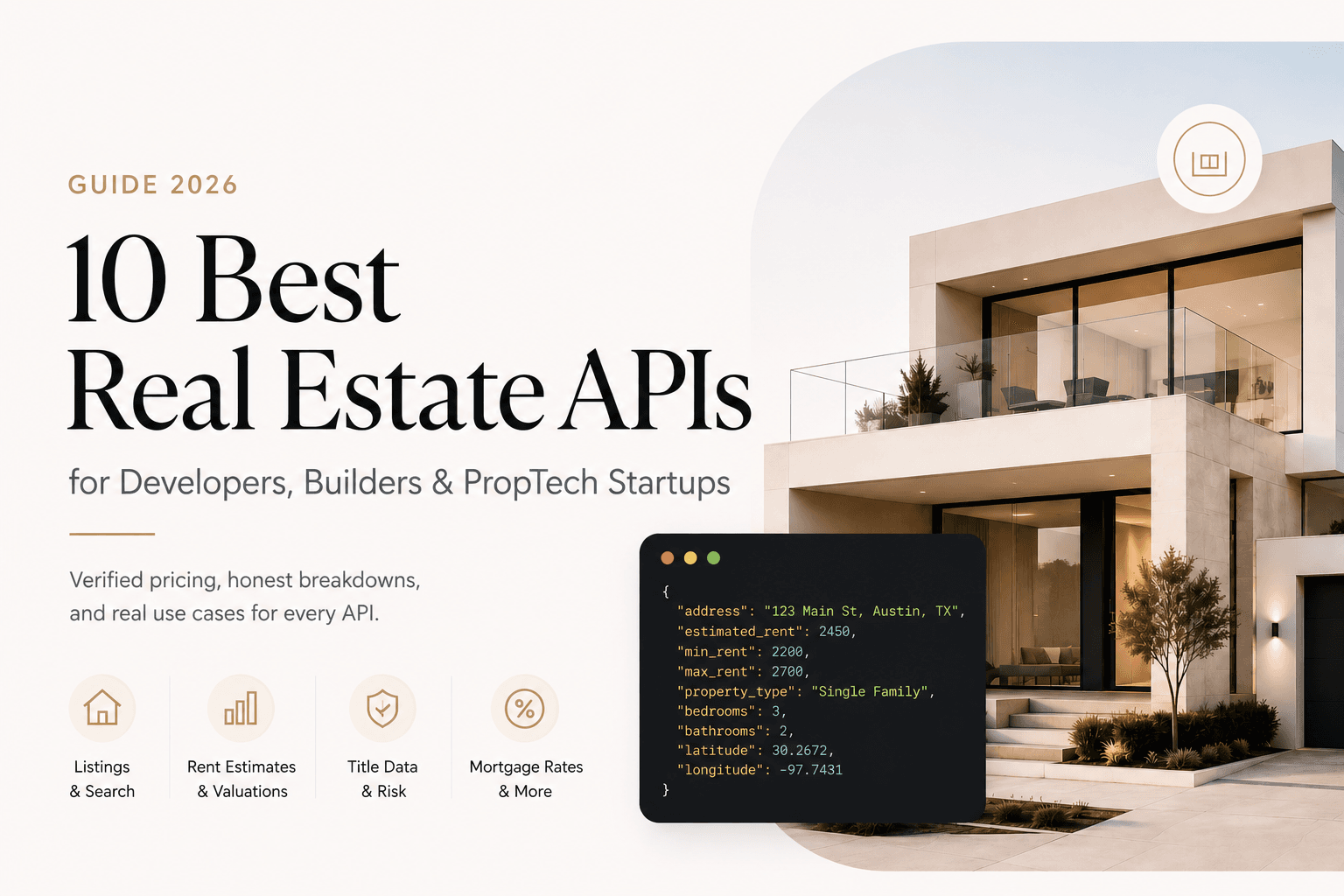
If you need rent estimates at scale, this is the most developer-friendly option available right now. You pass in a US address and get back an estimated monthly rent, a min-max range, property type, bedroom count, bathroom count, and lat/long coordinates in one response.


It is built for PropTech builders who need fast, production-ready rent data without managing complex scraping infrastructure or navigating enterprise contracts.


Key Features:

  • Estimated monthly rent for any US property address
  • Min and max rent range alongside the central estimate
  • Property type classification (single-family, multi-family, etc.)
  • Lat/long coordinates returned with every response
  • Supports estimation when bedroom/bathroom data is unavailable
  • Optimized for high-volume, production-level usage


Pricing:

  • FREE: 7-day trial, 10 API units, $0, no credit card required
  • STARTER: $50/month, 225 API units, hard limit
  • PRO: $180/month, 1,250 API units, hard limit
  • MEGA: Higher volume tier available on the listing page


Real Use Cases:


Say you run a property management SaaS. Landlords upload a list of addresses each month and want to know what rent to charge. Instead of paying for manual appraisals, you loop through the list, call the API for each address, and return a rent estimate table in seconds.


Or you're an investor evaluating 50 properties across a target city. You write a script, call the API for each address, and filter down to properties where the estimated rent clears your yield threshold. That workflow used to take days.


The API also connects to no-code tools like n8n and Zapier. You don't need to be a developer to run rent estimates at scale.


2. Realtor Real Estate Listings API by Veer Hanuman


This is the broadest real estate data API in the API.market catalog. It gives you real-time access to Realtor.com property listings, full property details, nearby homes, similar properties, school data, open houses, agent search, mortgage rates, loan analysis, and off-market property links, all from one integration.


If you are building a general property search platform, an investment dashboard, or a lead generation tool and you want one API to handle most of the data layer, this is it.


Key Features:

  • Property search by city, ZIP code, or location
  • Full property details: media, basics, tax history, open houses
  • Nearby and similar property results for comparison views
  • School search and school-by-property data for education-driven home search
  • Agent search, featured agents, and branding profiles by ZIP code
  • Mortgage rates and loan analysis data included
  • Off-market property links for additional research


Pricing:

  • FREE: Included, no credit card required
  • PRO: $12.99/month, 3,500 API units, hard limit
  • MEGA: $59.99/month, 30,000 API units, hard limit
  • GOLD: Higher volume tier available on the listing page


Real Use Cases:


You're a PropTech startup building a school-based home search app. Parents want to find homes near top-rated schools in a specific district. With this API, you query school data by city, pull nearby properties, and filter listings by school rating, all in one integration.


Or you're building an internal brokerage tool. Agents need to pull property details, find comps, check open houses, and surface nearby listings without logging into multiple platforms. You can build that entire workflow in one app powered by a single API.


Lead generation platforms get a lot of value here too. You can pull active listings in a target ZIP, identify properties matching investment criteria, and surface agent contact data, automating a sales funnel that previously required hours of manual research.


3. PropertyTitle API by NicheAPI LLC


Most real estate APIs tell you what a property is worth or what it rents for. This one tells you whether it is actually safe to buy.


The PropertyTitle API generates a composite encumbrance score (0-100) for any property by analyzing 7 independent risk categories: liens, easements, chain-of-title defects, court judgments, HOA delinquencies, tax liens, and deed restrictions. Every score maps to one of five risk bands, from Clean Title through Unmarketable Title, each with a recommended action.


For title agencies, real estate investors, lenders, and PropTech platforms doing pre-acquisition due diligence, this API solves a problem no other tool on this list addresses.


Key Features:

  • Composite encumbrance score (0-100) across 7 risk categories
  • Five risk bands: Clean Title, Low Risk, Moderate Risk, High Risk, Unmarketable Title
  • Detects mechanic's liens, tax liens, HOA delinquencies, IRS liens, judgment liens, and more
  • Chain-of-title analysis flags defective deeds, probate gaps, and forgeries
  • Batch analysis of up to 50 properties in a single request
  • Portfolio comparison across 2-10 properties
  • Custom factor weights to tailor the scoring model to your use case
  • 60 sample properties spanning 13 states for prototyping


Pricing:

  • FREE: Included, no credit card required
  • PRO: $49/month, 5,000 API units, soft limit, $0.05 per extra unit, 12 endpoints
  • MEGA: $149/month, 50,000 API units, soft limit, $0.05 per extra unit, 12 endpoints
  • BULK: Higher volume tier available on the listing page


Real Use Cases:


You run an acquisition pipeline and 20-30 properties come through screening each week. Instead of ordering a full title search for every one (which costs money and takes time), you run a batch call through the PropertyTitle API first. Properties scoring above 55 get flagged for deeper review. The rest move forward faster.


Lenders have a strong case for this too. Before funding a deal, you want a quick read on lien priority and tax status. This API gives you that without manually pulling county records for each address.


Title agencies can embed the composite score into their workflow tools directly, giving buyers and investors a "title health" indicator at the point of discovery, before they are deep into a transaction.


4. RentCast


RentCast is one of the most complete US rental and property data APIs available to independent developers. It covers 140 million properties with endpoints for property records, AVM valuations, rent estimates, rental comps, active listings, and market trends across 38,000+ ZIP codes.


What makes it stand out is the combination of breadth and accessibility. You get a generous free tier, clear documentation, a Zapier integration, and no contracts.


Key Features:

  • Property records for 140 million US residential and commercial properties
  • AVM valuations and rent estimates with comparable properties included
  • Active for-sale and for-rent listings across all 50 states
  • Market trend data by ZIP code covering averages, history, and listing stats
  • Owner details included in property records
  • MCP server support for AI/no-code workflows
  • Processes 500,000+ property record updates daily


Pricing:

The Developer plan is free and includes 50 API calls per month with no credit card required. The Foundation plan is $74/month for 1,000 requests ($0.06 per extra request). Growth is $199/month for 5,000 requests ($0.03 per extra request). Scale is $449/month for 25,000 requests ($0.015 per extra request). Enterprise custom plans are available for higher volumes.


Real Use Cases:


Rental property investors use RentCast to run market analysis across multiple ZIP codes before deciding where to buy. They pull average rent by property type, see how many units are actively listed, and track how prices have moved over time, all through the API.


CRMs built for property managers use the owner details endpoint to enrich leads. When a property goes into distress or a new listing appears, the CRM can automatically pull owner contact information and trigger an outreach workflow.


5. ATTOM Data API


ATTOM is the enterprise standard for comprehensive US property data. It covers 160 million properties with data including property characteristics, ownership history, deeds, mortgages, tax assessments, AVM valuations, foreclosure data, neighborhood demographics, school ratings, and natural hazard/climate exposure scores.


If you are building a product for lenders, insurers, government agencies, or enterprise PropTech, ATTOM gives you depth and reliability that consumer-grade APIs cannot match.


Key Features:

  • 160 million US properties with multi-source, normalized data
  • Deed, mortgage, and transaction records
  • AVM valuations and rental AVMs
  • Tax assessment and property tax history
  • Foreclosure and pre-foreclosure data
  • Neighborhood demographics and school ratings
  • Natural hazard and climate exposure scoring
  • AI-native and cloud delivery (Snowflake, Databricks) available
  • Formal SLAs and enterprise licensing for redistribution


Pricing:

ATTOM offers a free 30-day trial on their Property API with no credit card required. After the trial, pricing is custom and quote-based. Third-party sources consistently place entry-level production access starting around $95/month. Enterprise contracts scale based on data volume, delivery method (API vs. bulk vs. cloud), and licensing terms. Contact their data team at attomdata.com for a tailored quote.


Real Use Cases:


Lenders use ATTOM to pre-fill loan applications with property data, verify collateral values, and run borrower prequalification checks. Instead of manual data entry, the origination workflow pulls property tax records, AVM, and ownership history automatically.


Insurance underwriters integrate ATTOM's natural hazard and climate exposure endpoints to score properties for flood, fire, and earthquake risk before issuing a policy, reducing underwriting time significantly.


6. RealEstateAPI.com (REAPI)


REAPI is a developer-first property data platform targeting PropTech startups that need flexible, expressive access to US real estate records. It covers 159 million+ US properties with endpoints for property search, property details, AVM comps, parcel boundaries, address autocomplete, and skip tracing.


It is designed for builders who want clean JSON responses, fast sub-1-second latency, and a data model that supports complex filtering and advanced use cases like skip tracing and parcel mapping.


Key Features:

  • 159 million US property records with sub-1-second response times
  • Property search with advanced filtering across dozens of parameters
  • AVM comparable sales and rental comps
  • Parcel boundary data for mapping and GIS use cases
  • Address autocomplete for search UI experiences
  • Skip tracing for owner contact information
  • Designed for high-volume PropTech integrations


Pricing:

  • Starter: $599/month, 30,000 credits β€” address autocomplete, property search (100+ parameters), property details, standard comps, online support
  • Growth: $1,200/month, 150,000 credits β€” all Starter features plus custom comps, parcel boundaries, map pins, address verification, priority support and onboarding
  • Pro: $2,500/month, 400,000 credits β€” all Growth features plus saved search and bulk endpoints
  • Enterprise: Custom credit allocation β€” all Pro features, dedicated solutions engineer, SLAs, white-glove support, and custom development


Real Use Cases:


PropTech startups building investor prospecting tools use REAPI's skip tracing endpoint to surface owner contact data alongside property records. You can search for distressed properties by criteria, find who owns them, and feed those leads directly into a CRM.


Mapping products use the parcel boundary data to render accurate lot outlines on property maps, which is a feature most standard real estate APIs simply don't offer.


7. Mashvisor API


Mashvisor is built specifically for real estate investment analysis. Its API gives you MLS and off-market listings, historical sales, rental comps, and AI-driven analytics for both traditional long-term rentals and short-term Airbnb-style rentals, all in one platform.


If you are building an investment tool and your users are asking "should I buy this property and what will it earn?", Mashvisor gives you the analytics layer to answer that question.


Key Features:

  • Investment property analytics for long-term and short-term rentals
  • Airbnb occupancy rate projections and revenue estimates
  • Cap rate modeling and cash-on-cash return calculations
  • MLS and off-market listings included
  • Rental comps and market-level performance data
  • Nationwide US coverage
  • AI-powered investment scoring per property


Pricing:

Mashvisor's data API starts at $129/month for small-scale access. Pricing is credit-based, with each plan offering a monthly credit volume. A 7-day free trial includes 30 credits so you can test endpoints before paying. Higher-volume and enterprise plans are negotiated directly with their team. Annual billing is available at a discount.


Real Use Cases:


You're building an investment platform for real estate buyers. Instead of showing raw listing data, you want to surface a rental ROI score for every property in the search results. Mashvisor's API gives you the cap rate, estimated monthly cash flow, and Airbnb performance projection for each property, letting your users make data-driven investment decisions.


Short-term rental hosts and property managers also use the platform to benchmark their performance against nearby Airbnb listings and adjust pricing based on market occupancy trends. If you need to pull live Airbnb listing and availability data directly, our Airbnb API integration guide walks through how to set that up.


8. AirDNA API


AirDNA is the leading data source for short-term rental analytics. Its API exposes Airbnb and vacation rental performance metrics across global markets including occupancy rates, average daily rates, revenue projections, market seasonality, and property-level STR performance.


If you are building anything for the vacation rental market, from investment tools to revenue optimization software, AirDNA has no direct competitor. And if you need to pull live Airbnb listing data directly into your app, check out our guide to Airbnb API integration for a step-by-step breakdown.


Key Features:

  • Airbnb and STR occupancy rates by market and property
  • Average daily rate (ADR) and revenue projections
  • Market-level seasonality and demand trends
  • Property-level STR performance benchmarks
  • Global market coverage across hundreds of cities
  • Rentalizer tool for investment projections


Pricing:

AirDNA's dashboard pricing is per market and scales with market size. A market with fewer than 100 active listings costs $19.95/month. Markets with 100 to 1,000 listings cost $39.95/month. Markets with over 1,000 listings cost $99.95/month. Full global access across all markets is $999.95/month (or $599.99/month billed annually). For bulk API access or developer integrations beyond the dashboard, contact their enterprise team directly.


Real Use Cases:


STR investors use AirDNA before buying a vacation rental property. They pull occupancy rates and average daily rates for comparable properties in a target market, model out annual revenue, and compare it against the purchase price. That analysis gets a lot more reliable when it's based on actual performance data rather than estimates.


Revenue management platforms for property managers use the ADR benchmarks to automatically adjust nightly pricing based on how nearby listings are performing and what upcoming demand looks like.


9. HouseCanary API


Most real estate APIs tell you what a property is worth right now. HouseCanary tells you where it's going.


It combines AVM valuations with AI-powered forecasting rental projections, price growth estimates, and market volatility metrics across more than 75 data points at the property, ZIP code, MSA, and state level. For investors and lenders who need forward-looking data, not just current snapshots, this is the API that fills that gap.


Key Features:

  • AVM property valuations with confidence scores
  • AI-powered price growth and rental projections
  • 75+ data points across property, block, ZIP, MSA, and state levels
  • Rental value estimates and rental comparable properties
  • Market condition data including value tiers, volatility, and liquidity scores
  • Historical price trend data going back multiple years
  • RESTful API with JSON output and developer documentation


Pricing:

Plans start at $19/month for entry-level access. API usage fees range from $0.30 to $6.00 per successful call depending on the endpoint. Higher-tier plans reduce the per-call cost , for example, basic endpoint calls drop from $0.50 on the entry plan to $0.30 on the Teams plan. Annual subscriptions include up to 17% off monthly pricing. Visit housecanary.com for full tier details.


Real Use Cases:


You're building a buy-vs-rent calculator for a consumer mortgage app. A user enters an address, and you want to show not just the current value but a 3-year price projection alongside the rental estimate. One HouseCanary call gives you both, which is something most standard AVMs don't offer in a single response.


Or you run a portfolio monitoring tool for institutional landlords. Every month you pull updated valuations and volatility scores for each property in the portfolio, flag any asset where projected growth has dropped below the acquisition yield threshold, and surface it for review.


That workflow used to require a human analyst. Lenders also use HouseCanary at the origination stage. Before underwriting a deal, they pull the AVM confidence score for the collateral property. A low confidence score flags the property for a full appraisal rather than a desktop review, saving time on deals that would have failed anyway.


10. SimplyRETS (MLS Data API)


SimplyRETS is the cleanest way to access MLS data if you are a licensed agent, broker, or building a product that works with MLS-connected clients. It normalizes RETS and RESO Web API feeds from regional MLS systems into a single, consistent REST API.


If your product needs authoritative, real-time MLS listing data tied to a specific brokerage or MLS region, SimplyRETS is the standard integration layer that most IDX developers use.


Key Features:

  • Listings API with hundreds of search and filter parameters
  • Open houses API for current and historical open house data
  • Agents API for building agent profile pages with active listings
  • Market analytics API for local listing statistics and averages
  • Normalized data model across multiple MLS providers
  • RETS and RESO Web API feed integration
  • WordPress plugin available for non-developer setups


Pricing:

There is a one-time $99 connection fee per MLS feed, then a monthly plan. The Basic plan is $49/month and covers residential, condo, and rental listings with active and pending statuses.


The Premium plan is $99/month and adds multifamily, commercial, and land listings plus closed status data. Enterprise is $199/month and adds open houses on top of everything in Premium. Add-ons include geocoding ($15/month per feed), market analytics API ($40/month per feed), and agents API ($40/month per feed). No long-term contracts required.


Real Use Cases:


Real estate brokerages use SimplyRETS to build their own IDX websites. Instead of using a generic third-party search portal, they embed live MLS listings directly on their brokerage website with full control over the search experience and branding.


Individual agents building their personal real estate websites use SimplyRETS to show their own active listings and all properties in their MLS board, keeping buyers on their site rather than sending them to Zillow or Realtor.com.


Does Zillow Have an API?


This is one of the most-searched questions in the real estate API space, and the answer is: yes, but not in the way most developers expect.


The Zillow API does exist Zillow offers access through its developer program at zillowgroup.com/developers, covering Zestimates, MLS and broker listings, mortgage rates, rentals, agent reviews, and public records data. But the Zillow API is restricted to approved partners and specific use cases. You cannot sign up as an independent developer and start making calls today.


If you need Zillow-style data (rent estimates, listing details, property valuations) through open developer access, the APIs in this list, particularly the Rent Estimate API and Realtor Real Estate Listings API on API.market, give you that same type of data through endpoints you can access today without a partnership approval process.


Frequently Asked Questions


1. What is an API used for in real estate?


A real estate API connects your application to live property data including listings, rent estimates, AVM valuations, title records, school ratings, owner information, and mortgage rates. Developers use them to build property search platforms, investment tools, rental apps, lead generation systems, title screening workflows, and due diligence tools. The core benefit is scale: an API turns manual property research into an automated function call.


2. Does Zillow have an API?


Yes. Zillow offers API access through its developer program at zillowgroup.com/developers, covering Zestimates, MLS listings, mortgage rates, rental data, and public records. But access requires partner approval and is not available to independent developers on demand. If you need Zillow-style data through open developer access, the Rent Estimate API and Realtor Real Estate Listings API on API.market are the most practical alternatives available today.


3. How do I choose the right real estate data API?


Start with the data type you actually need, whether that is listings, rent estimates, title intelligence, investment analytics, or MLS data. Then look at call volume and whether the API offers a free tier to prototype. Check documentation quality before committing to any paid plan, and verify whether the pricing model (per call, per month, per seat) fits your product's usage pattern. Every API on this list offers either a free tier or a free trial so you can test before you pay.


4. What real estate APIs have a free tier?


RentCast offers 50 free API calls per month. The PropertyTitle API on API.market includes 100 free requests per month. The Realtor Listings API on API.market includes 10 free calls per month. ATTOM offers a 30-day free trial. RealEstateAPI.com includes a 7-day free trial. AirDNA provides limited free market data for individual markets. SimplyRETS offers a free sandbox environment with test data.


5. What is the difference between a real estate listing API and a property data API?


A listing API returns active for-sale or for-rent listings with current status, price, days on market, and listing contacts. A property data API returns static and historical records about a specific property including ownership history, tax assessments, structural attributes, and encumbrances. Most serious real estate applications need both.

10 Best Real Estate APIs in 2026 (Listings, Rent Estimates, Title Data & More)

Compare the best real estate APIs in 2026: Zillow API, Rent Estimate API, Realtor Listings API, PropertyTitle API, RentCast, ATTOM, Mashvisor, AirDNA, HouseCanary, and SimplyRETS with pricing and real use cases.
10 Best Real Estate APIs in 2026 (Listings, Rent Estimates, Title Data & More)

You're building a real estate product and you need data, but the moment you start shopping for a real estate API, you hit a wall. Some want enterprise contracts.

Others are restricted to approved partners (the Zillow API is the most common example developers run into). Some cover listings but not valuations. Others cover valuations but not title risk.

This guide cuts through all of that. Here are the 10 best real estate APIs in 2026 that we'll be covering in detail, complete with verified pricing, honest breakdowns, and clear use cases for each.

  1. Rent Estimate API by TheDataClouds (API.market)
  2. Realtor Real Estate Listings API by Veer Hanuman (API.market)
  3. PropertyTitle API by NicheAPI LLC (API.market)
  4. RentCast
  5. ATTOM Data API
  6. RealEstateAPI.com (REAPI)
  7. Mashvisor
  8. AirDNA
  9. Housecanary
  10. SimplyRETS

What Is a Real Estate API and Why Do Developers Use One?

A real estate API is a data connection. You send a request, you get back structured property data in JSON format: rent estimates, active listings, title risk scores, AVM valuations, ownership history, mortgage rates, and more.

You use one because pulling that data manually is not an option at scale. A real estate API turns what would be hours of research into a single function call.

Common things you can build with a real estate data API:

  • Property search and listing platforms
  • Rent estimate calculators for tenant-facing apps
  • Title risk screening tools for acquisition workflows
  • Investment analysis dashboards comparing rental ROI
  • Lead generation systems targeting active listings
  • Mortgage affordability tools pulling live rate data

Every product in this list solves at least one of these problems. Which one you need depends on what you're building.


How to Pick the Right Real Estate API

Not every API fits every product. Before you commit to one, work through these questions:

  • What data type do you actually need? Listings, rent estimates, title intelligence, valuation models, and school data are all different endpoints, often from different providers.
  • What is your call volume? A prototype needs 50-100 calls per month. A production app could need millions.
  • Do you need a free tier? Most good APIs offer one. If they don't, find one that does so you can test before paying.
  • What is your integration timeline? Some APIs have extensive documentation and sandbox environments. Others require a sales call before you can write a single line of code.
  • Does the data need to be real-time? Active listings go stale fast. Title records and tax data do not change daily. Pick accordingly.

With those answers in hand, here are the top 10 real estate APIs available in 2026.


The 10 Best Real Estate APIs in 2026


1. Rent Estimate API by TheDataClouds

If you need rent estimates at scale, this is the most developer-friendly option available right now. You pass in a US address and get back an estimated monthly rent, a min-max range, property type, bedroom count, bathroom count, and lat/long coordinates in one response.

It is built for PropTech builders who need fast, production-ready rent data without managing complex scraping infrastructure or navigating enterprise contracts.

Key Features:

  • Estimated monthly rent for any US property address
  • Min and max rent range alongside the central estimate
  • Property type classification (single-family, multi-family, etc.)
  • Lat/long coordinates returned with every response
  • Supports estimation when bedroom/bathroom data is unavailable
  • Optimized for high-volume, production-level usage

Pricing:

  • FREE: 7-day trial, 10 API units, $0, no credit card required
  • STARTER: $50/month, 225 API units, hard limit
  • PRO: $180/month, 1,250 API units, hard limit
  • MEGA: Higher volume tier available on the listing page

Real Use Cases:

Say you run a property management SaaS. Landlords upload a list of addresses each month and want to know what rent to charge. Instead of paying for manual appraisals, you loop through the list, call the API for each address, and return a rent estimate table in seconds.

Or you're an investor evaluating 50 properties across a target city. You write a script, call the API for each address, and filter down to properties where the estimated rent clears your yield threshold. That workflow used to take days.

The API also connects to no-code tools like n8n and Zapier. You don't need to be a developer to run rent estimates at scale.


2. Realtor Real Estate Listings API by Veer Hanuman

This is the broadest real estate data API in the API.market catalog. It gives you real-time access to Realtor.com property listings, full property details, nearby homes, similar properties, school data, open houses, agent search, mortgage rates, loan analysis, and off-market property links, all from one integration.

If you are building a general property search platform, an investment dashboard, or a lead generation tool and you want one API to handle most of the data layer, this is it.

Key Features:

  • Property search by city, ZIP code, or location
  • Full property details: media, basics, tax history, open houses
  • Nearby and similar property results for comparison views
  • School search and school-by-property data for education-driven home search
  • Agent search, featured agents, and branding profiles by ZIP code
  • Mortgage rates and loan analysis data included
  • Off-market property links for additional research

Pricing:

  • FREE: Included, no credit card required
  • PRO: $12.99/month, 3,500 API units, hard limit
  • MEGA: $59.99/month, 30,000 API units, hard limit
  • GOLD: Higher volume tier available on the listing page

Real Use Cases:

You're a PropTech startup building a school-based home search app. Parents want to find homes near top-rated schools in a specific district. With this API, you query school data by city, pull nearby properties, and filter listings by school rating, all in one integration.

Or you're building an internal brokerage tool. Agents need to pull property details, find comps, check open houses, and surface nearby listings without logging into multiple platforms. You can build that entire workflow in one app powered by a single API.

Lead generation platforms get a lot of value here too. You can pull active listings in a target ZIP, identify properties matching investment criteria, and surface agent contact data, automating a sales funnel that previously required hours of manual research.

3. PropertyTitle API by NicheAPI LLC

Most real estate APIs tell you what a property is worth or what it rents for. This one tells you whether it is actually safe to buy.

The PropertyTitle API generates a composite encumbrance score (0-100) for any property by analyzing 7 independent risk categories: liens, easements, chain-of-title defects, court judgments, HOA delinquencies, tax liens, and deed restrictions. Every score maps to one of five risk bands, from Clean Title through Unmarketable Title, each with a recommended action.

For title agencies, real estate investors, lenders, and PropTech platforms doing pre-acquisition due diligence, this API solves a problem no other tool on this list addresses.

Key Features:

  • Composite encumbrance score (0-100) across 7 risk categories
  • Five risk bands: Clean Title, Low Risk, Moderate Risk, High Risk, Unmarketable Title
  • Detects mechanic's liens, tax liens, HOA delinquencies, IRS liens, judgment liens, and more
  • Chain-of-title analysis flags defective deeds, probate gaps, and forgeries
  • Batch analysis of up to 50 properties in a single request
  • Portfolio comparison across 2-10 properties
  • Custom factor weights to tailor the scoring model to your use case
  • 60 sample properties spanning 13 states for prototyping

Pricing:

  • FREE: Included, no credit card required
  • PRO: $49/month, 5,000 API units, soft limit, $0.05 per extra unit, 12 endpoints
  • MEGA: $149/month, 50,000 API units, soft limit, $0.05 per extra unit, 12 endpoints
  • BULK: Higher volume tier available on the listing page

Real Use Cases:

You run an acquisition pipeline and 20-30 properties come through screening each week. Instead of ordering a full title search for every one (which costs money and takes time), you run a batch call through the PropertyTitle API first. Properties scoring above 55 get flagged for deeper review. The rest move forward faster.

Lenders have a strong case for this too. Before funding a deal, you want a quick read on lien priority and tax status. This API gives you that without manually pulling county records for each address.

Title agencies can embed the composite score into their workflow tools directly, giving buyers and investors a "title health" indicator at the point of discovery, before they are deep into a transaction.

4. RentCast

RentCast is one of the most complete US rental and property data APIs available to independent developers. It covers 140 million properties with endpoints for property records, AVM valuations, rent estimates, rental comps, active listings, and market trends across 38,000+ ZIP codes.

What makes it stand out is the combination of breadth and accessibility. You get a generous free tier, clear documentation, a Zapier integration, and no contracts.

Key Features:

  • Property records for 140 million US residential and commercial properties
  • AVM valuations and rent estimates with comparable properties included
  • Active for-sale and for-rent listings across all 50 states
  • Market trend data by ZIP code covering averages, history, and listing stats
  • Owner details included in property records
  • MCP server support for AI/no-code workflows
  • Processes 500,000+ property record updates daily

Pricing:

The Developer plan is free and includes 50 API calls per month with no credit card required. The Foundation plan is $74/month for 1,000 requests ($0.06 per extra request). Growth is $199/month for 5,000 requests ($0.03 per extra request). Scale is $449/month for 25,000 requests ($0.015 per extra request). Enterprise custom plans are available for higher volumes.

Real Use Cases:

Rental property investors use RentCast to run market analysis across multiple ZIP codes before deciding where to buy. They pull average rent by property type, see how many units are actively listed, and track how prices have moved over time, all through the API.

CRMs built for property managers use the owner details endpoint to enrich leads. When a property goes into distress or a new listing appears, the CRM can automatically pull owner contact information and trigger an outreach workflow.


5. ATTOM Data API

ATTOM is the enterprise standard for comprehensive US property data. It covers 160 million properties with data including property characteristics, ownership history, deeds, mortgages, tax assessments, AVM valuations, foreclosure data, neighborhood demographics, school ratings, and natural hazard/climate exposure scores.

If you are building a product for lenders, insurers, government agencies, or enterprise PropTech, ATTOM gives you depth and reliability that consumer-grade APIs cannot match.

Key Features:

  • 160 million US properties with multi-source, normalized data
  • Deed, mortgage, and transaction records
  • AVM valuations and rental AVMs
  • Tax assessment and property tax history
  • Foreclosure and pre-foreclosure data
  • Neighborhood demographics and school ratings
  • Natural hazard and climate exposure scoring
  • AI-native and cloud delivery (Snowflake, Databricks) available
  • Formal SLAs and enterprise licensing for redistribution

Pricing:

ATTOM offers a free 30-day trial on their Property API with no credit card required. After the trial, pricing is custom and quote-based. Third-party sources consistently place entry-level production access starting around $95/month. Enterprise contracts scale based on data volume, delivery method (API vs. bulk vs. cloud), and licensing terms. Contact their data team at attomdata.com for a tailored quote.

Real Use Cases:

Lenders use ATTOM to pre-fill loan applications with property data, verify collateral values, and run borrower prequalification checks. Instead of manual data entry, the origination workflow pulls property tax records, AVM, and ownership history automatically.

Insurance underwriters integrate ATTOM's natural hazard and climate exposure endpoints to score properties for flood, fire, and earthquake risk before issuing a policy, reducing underwriting time significantly.


6. RealEstateAPI.com (REAPI)

REAPI is a developer-first property data platform targeting PropTech startups that need flexible, expressive access to US real estate records. It covers 159 million+ US properties with endpoints for property search, property details, AVM comps, parcel boundaries, address autocomplete, and skip tracing.

It is designed for builders who want clean JSON responses, fast sub-1-second latency, and a data model that supports complex filtering and advanced use cases like skip tracing and parcel mapping.

Key Features:

  • 159 million US property records with sub-1-second response times
  • Property search with advanced filtering across dozens of parameters
  • AVM comparable sales and rental comps
  • Parcel boundary data for mapping and GIS use cases
  • Address autocomplete for search UI experiences
  • Skip tracing for owner contact information
  • Designed for high-volume PropTech integrations

Pricing:

  • Starter: $599/month, 30,000 credits β€” address autocomplete, property search (100+ parameters), property details, standard comps, online support
  • Growth: $1,200/month, 150,000 credits β€” all Starter features plus custom comps, parcel boundaries, map pins, address verification, priority support and onboarding
  • Pro: $2,500/month, 400,000 credits β€” all Growth features plus saved search and bulk endpoints
  • Enterprise: Custom credit allocation β€” all Pro features, dedicated solutions engineer, SLAs, white-glove support, and custom development

Real Use Cases:

PropTech startups building investor prospecting tools use REAPI's skip tracing endpoint to surface owner contact data alongside property records. You can search for distressed properties by criteria, find who owns them, and feed those leads directly into a CRM.

Mapping products use the parcel boundary data to render accurate lot outlines on property maps, which is a feature most standard real estate APIs simply don't offer.


7. Mashvisor API

Mashvisor is built specifically for real estate investment analysis. Its API gives you MLS and off-market listings, historical sales, rental comps, and AI-driven analytics for both traditional long-term rentals and short-term Airbnb-style rentals, all in one platform.

If you are building an investment tool and your users are asking "should I buy this property and what will it earn?", Mashvisor gives you the analytics layer to answer that question.

Key Features:

  • Investment property analytics for long-term and short-term rentals
  • Airbnb occupancy rate projections and revenue estimates
  • Cap rate modeling and cash-on-cash return calculations
  • MLS and off-market listings included
  • Rental comps and market-level performance data
  • Nationwide US coverage
  • AI-powered investment scoring per property

Pricing:

Mashvisor's data API starts at $129/month for small-scale access. Pricing is credit-based, with each plan offering a monthly credit volume. A 7-day free trial includes 30 credits so you can test endpoints before paying. Higher-volume and enterprise plans are negotiated directly with their team. Annual billing is available at a discount.

Real Use Cases:

You're building an investment platform for real estate buyers. Instead of showing raw listing data, you want to surface a rental ROI score for every property in the search results. Mashvisor's API gives you the cap rate, estimated monthly cash flow, and Airbnb performance projection for each property, letting your users make data-driven investment decisions.

Short-term rental hosts and property managers also use the platform to benchmark their performance against nearby Airbnb listings and adjust pricing based on market occupancy trends. If you need to pull live Airbnb listing and availability data directly, our Airbnb API integration guide walks through how to set that up.

8. AirDNA API

AirDNA is the leading data source for short-term rental analytics. Its API exposes Airbnb and vacation rental performance metrics across global markets including occupancy rates, average daily rates, revenue projections, market seasonality, and property-level STR performance.

If you are building anything for the vacation rental market, from investment tools to revenue optimization software, AirDNA has no direct competitor. And if you need to pull live Airbnb listing data directly into your app, check out our guide to Airbnb API integration for a step-by-step breakdown.

Key Features:

  • Airbnb and STR occupancy rates by market and property
  • Average daily rate (ADR) and revenue projections
  • Market-level seasonality and demand trends
  • Property-level STR performance benchmarks
  • Global market coverage across hundreds of cities
  • Rentalizer tool for investment projections

Pricing:

AirDNA's dashboard pricing is per market and scales with market size. A market with fewer than 100 active listings costs $19.95/month. Markets with 100 to 1,000 listings cost $39.95/month. Markets with over 1,000 listings cost $99.95/month. Full global access across all markets is $999.95/month (or $599.99/month billed annually). For bulk API access or developer integrations beyond the dashboard, contact their enterprise team directly.

Real Use Cases:

STR investors use AirDNA before buying a vacation rental property. They pull occupancy rates and average daily rates for comparable properties in a target market, model out annual revenue, and compare it against the purchase price. That analysis gets a lot more reliable when it's based on actual performance data rather than estimates.

Revenue management platforms for property managers use the ADR benchmarks to automatically adjust nightly pricing based on how nearby listings are performing and what upcoming demand looks like.

9. HouseCanary API

Most real estate APIs tell you what a property is worth right now. HouseCanary tells you where it's going.

It combines AVM valuations with AI-powered forecasting rental projections, price growth estimates, and market volatility metrics across more than 75 data points at the property, ZIP code, MSA, and state level. For investors and lenders who need forward-looking data, not just current snapshots, this is the API that fills that gap.

Key Features:

  • AVM property valuations with confidence scores
  • AI-powered price growth and rental projections
  • 75+ data points across property, block, ZIP, MSA, and state levels
  • Rental value estimates and rental comparable properties
  • Market condition data including value tiers, volatility, and liquidity scores
  • Historical price trend data going back multiple years
  • RESTful API with JSON output and developer documentation

Pricing:

Plans start at $19/month for entry-level access. API usage fees range from $0.30 to $6.00 per successful call depending on the endpoint. Higher-tier plans reduce the per-call cost , for example, basic endpoint calls drop from $0.50 on the entry plan to $0.30 on the Teams plan. Annual subscriptions include up to 17% off monthly pricing. Visit housecanary.com for full tier details.

Real Use Cases:

You're building a buy-vs-rent calculator for a consumer mortgage app. A user enters an address, and you want to show not just the current value but a 3-year price projection alongside the rental estimate. One HouseCanary call gives you both, which is something most standard AVMs don't offer in a single response.

Or you run a portfolio monitoring tool for institutional landlords. Every month you pull updated valuations and volatility scores for each property in the portfolio, flag any asset where projected growth has dropped below the acquisition yield threshold, and surface it for review.

That workflow used to require a human analyst. Lenders also use HouseCanary at the origination stage. Before underwriting a deal, they pull the AVM confidence score for the collateral property. A low confidence score flags the property for a full appraisal rather than a desktop review, saving time on deals that would have failed anyway.

10. SimplyRETS (MLS Data API)

SimplyRETS is the cleanest way to access MLS data if you are a licensed agent, broker, or building a product that works with MLS-connected clients. It normalizes RETS and RESO Web API feeds from regional MLS systems into a single, consistent REST API.

If your product needs authoritative, real-time MLS listing data tied to a specific brokerage or MLS region, SimplyRETS is the standard integration layer that most IDX developers use.

Key Features:

  • Listings API with hundreds of search and filter parameters
  • Open houses API for current and historical open house data
  • Agents API for building agent profile pages with active listings
  • Market analytics API for local listing statistics and averages
  • Normalized data model across multiple MLS providers
  • RETS and RESO Web API feed integration
  • WordPress plugin available for non-developer setups

Pricing:

There is a one-time $99 connection fee per MLS feed, then a monthly plan. The Basic plan is $49/month and covers residential, condo, and rental listings with active and pending statuses.

The Premium plan is $99/month and adds multifamily, commercial, and land listings plus closed status data. Enterprise is $199/month and adds open houses on top of everything in Premium. Add-ons include geocoding ($15/month per feed), market analytics API ($40/month per feed), and agents API ($40/month per feed). No long-term contracts required.

Real Use Cases:

Real estate brokerages use SimplyRETS to build their own IDX websites. Instead of using a generic third-party search portal, they embed live MLS listings directly on their brokerage website with full control over the search experience and branding.

Individual agents building their personal real estate websites use SimplyRETS to show their own active listings and all properties in their MLS board, keeping buyers on their site rather than sending them to Zillow or Realtor.com.

Does Zillow Have an API?

This is one of the most-searched questions in the real estate API space, and the answer is: yes, but not in the way most developers expect.

The Zillow API does exist Zillow offers access through its developer program at zillowgroup.com/developers, covering Zestimates, MLS and broker listings, mortgage rates, rentals, agent reviews, and public records data. But the Zillow API is restricted to approved partners and specific use cases. You cannot sign up as an independent developer and start making calls today.

If you need Zillow-style data (rent estimates, listing details, property valuations) through open developer access, the APIs in this list, particularly the Rent Estimate API and Realtor Real Estate Listings API on API.market, give you that same type of data through endpoints you can access today without a partnership approval process.

Frequently Asked Questions

1. What is an API used for in real estate?

A real estate API connects your application to live property data including listings, rent estimates, AVM valuations, title records, school ratings, owner information, and mortgage rates. Developers use them to build property search platforms, investment tools, rental apps, lead generation systems, title screening workflows, and due diligence tools. The core benefit is scale: an API turns manual property research into an automated function call.

2. Does Zillow have an API?

Yes. Zillow offers API access through its developer program at zillowgroup.com/developers, covering Zestimates, MLS listings, mortgage rates, rental data, and public records. But access requires partner approval and is not available to independent developers on demand. If you need Zillow-style data through open developer access, the Rent Estimate API and Realtor Real Estate Listings API on API.market are the most practical alternatives available today.

3. How do I choose the right real estate data API?

Start with the data type you actually need, whether that is listings, rent estimates, title intelligence, investment analytics, or MLS data. Then look at call volume and whether the API offers a free tier to prototype. Check documentation quality before committing to any paid plan, and verify whether the pricing model (per call, per month, per seat) fits your product's usage pattern. Every API on this list offers either a free tier or a free trial so you can test before you pay.

4. What real estate APIs have a free tier?

RentCast offers 50 free API calls per month. The PropertyTitle API on API.market includes 100 free requests per month. The Realtor Listings API on API.market includes 10 free calls per month. ATTOM offers a 30-day free trial. RealEstateAPI.com includes a 7-day free trial. AirDNA provides limited free market data for individual markets. SimplyRETS offers a free sandbox environment with test data.

5. What is the difference between a real estate listing API and a property data API?

A listing API returns active for-sale or for-rent listings with current status, price, days on market, and listing contacts. A property data API returns static and historical records about a specific property including ownership history, tax assessments, structural attributes, and encumbrances. Most serious real estate applications need both.