You built something with Lovable. It worked. People are using it. Then the credits ran out mid-session, a small tweak broke something else, and now you're wondering if there's a better tool for where you are now. There is.
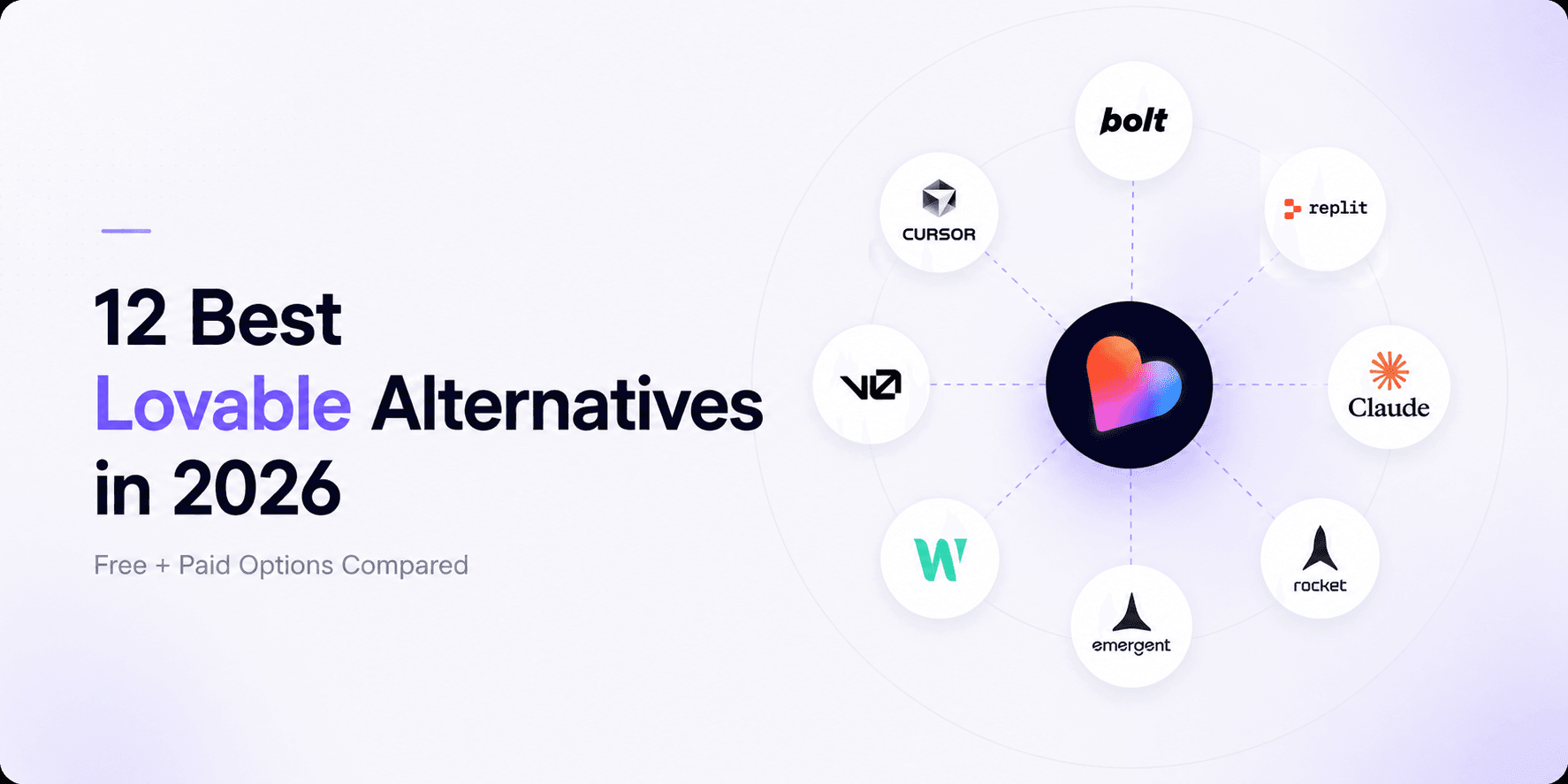
This lovable alternatives guide covers 12 real options in 2026, with verified pricing and real use cases for each:
- Bolt.new
- v0 by Vercel
- Replit Agent
- Cursor
- Devin
- GitHub Copilot
- Builder.io
- Dyad
- Bubble
- Emergent.sh
- Rocket.new
- Hercules
12 Best Lovable Alternatives in 2026
1. Bolt.new
Bolt.new is the most direct swap for Lovable if you want to stay in the browser. It runs on StackBlitz's cloud IDE infrastructure, which means you get full code visibility alongside the AI generation loop. You prompt, it builds, and you can read every line it writes.
Key Features:
- Full browser-based AI app builder with no local setup required
- Code editor view so you can read and manually edit everything the AI generates
- GitHub integration for pushing your project to a real repo
- Supports full-stack apps with Node.js backends, not just frontend
- Token rollover on paid plans so unused credits carry into the next month
- StackBlitz's WebContainers run a real Node environment in your browser tab
Pricing: Bolt.new has a free plan with 1 million tokens per month and a 300K daily limit. No credit card required. The Pro plan starts at $25/month for 10 million tokens, and higher Pro tiers go up to $50/month for 26 million tokens. Team plans start at $30 per member per month.
Real Use Cases:
You're prototyping a SaaS dashboard with a React frontend and a simple Node API. You describe it to Bolt, it scaffolds the structure, and you watch it write each file in the code panel.
When something looks off, you can jump in and edit directly rather than waiting for a re-generation. That hybrid approach, AI-first with human editing, is where Bolt shines over more black-box builders.
For developers who feel naked without a code editor visible, Bolt is the natural first move away from Lovable. The generation speed is comparable, but you're never in the dark about what the AI is actually doing.
2. v0 by Vercel
v0 is Vercel's AI tool for generating UI components and full pages. You describe a screen, it generates React, Tailwind CSS, and shadcn/ui components ready to drop into your codebase. It's not a hosted app builder. It's a UI scaffolding accelerator that feeds into your real project.
Key Features:
- Generates production-ready React components with Tailwind and shadcn/ui out of the box
- Full-page layouts, forms, dashboards, and modals from a single prompt
- Code output you own and can copy directly into any repo
- Integrated Vercel deployment so you can preview and ship from the same tool
- Iterative editing so you can refine each generation by prompting follow-up changes
- Credits-based pricing with a generous free tier to experiment before committing
Pricing: v0 offers a free tier with $5 in monthly credits, which resets each billing cycle. Team plans start at $30 per user per month, and Business is $100 per user per month for teams that need data privacy controls.
Real Use Cases:
You're a developer who already knows where your code lives and just wants to skip the slow part of drafting the initial UI. You describe a settings page with three sections and a save button, v0 generates it in under 30 seconds, and you paste it into your Next.js project. Done.
v0 pairs well with an IDE like Cursor or Devin. Use v0 to generate the initial components, then use your agentic editor to wire them up to your backend logic. That two-step workflow is what a lot of technical founders in 2026 are running.
3. Replit Agent
Replit Agent builds and runs apps entirely inside a hosted cloud environment. You describe what you want, the agent plans the architecture, writes the files, installs packages, runs the app, and reports back. The entire environment lives in your browser, which means there's nothing to set up locally.
Key Features:
- Autonomous agent builds full apps from a single prompt, including backend logic
- Everything runs in a hosted workspace with a live preview URL you can share
- Built-in database, storage, and authentication within the Replit ecosystem
- Real-time collaboration with up to five people on the Core plan
- Ghostwriter AI assists with completions and explanations while you work
- Usage-based credit system so you pay for what the agent actually does
Pricing: The Starter plan is free with limited daily credits and 1,200 development minutes per month. Replit Core is $20/month and includes $20 in monthly credits, access to the full Agent, and up to five collaborators. Replit Pro launched in early 2026 at $100/month for up to 15 builders, with credit discounts and rollover included.
Real Use Cases:
You want to build a tool that takes a CSV upload, processes it, and outputs a formatted report. You describe it to Replit Agent. It creates the upload handler, the processing logic, connects it to a simple database, and generates a download endpoint, all in one session. You never leave the browser.
Replit is especially good for technically curious non-developers who want to understand the code the AI generates. The workspace gives you visibility into every file without requiring you to configure a local development environment.
4. Cursor
Cursor is an AI-powered code editor for developers who are ready to work inside a real repository. It's not a hosted app builder. It's where you go when you want full ownership of your code from day one. You write, refactor, and debug with an AI that understands your entire codebase.
Key Features:
- Composer agent mode for autonomous multi-file editing across your repo
- Inline AI suggestions that understand your project structure and naming conventions
- Ask mode for asking questions about your code without making changes
- Works with your existing VS Code extensions, themes, and keybindings
- Connects to Claude, GPT-4, and other frontier models through Cursor's backend
- Reads your whole codebase so suggestions stay consistent with what you've already built
Pricing: Cursor has a free Hobby plan with limited Agent requests and Tab completions, no credit card required. Pro is $20/month with a credit pool for extended model usage. Pro+ is $60/month with 3x the usage credits. Teams are $40 per user per month with centralized billing, admin controls, and SSO.
Real Use Cases:
You have a working Lovable prototype that people love. You want to export the code and turn it into something scalable. You drop the code into Cursor, describe the refactor you need, and the Composer agent walks through the files, makes the changes, and shows you each diff before committing. That transition from prototype to real codebase is Cursor's strong suit.
If you're ready to move beyond prompt-and-preview workflows and become the owner of your stack, Cursor is where most serious builders end up.
5. Devin (Formerly Windsurf)
Devin is a full AI-powered IDE with a built-in agent called Cascade that handles multi-step, multi-file tasks. It's a standalone editor, not a VS Code extension, and it's priced more accessible than Cursor at every tier.
Key Features:
- Cascade agent mode for planning and executing tasks across multiple files at once
- Inline tab completion that understands your full project context
- Codebase indexing so the AI knows your architecture, not just the file you have open
- Supports Claude, GPT-4o, and other frontier models
- Daily and weekly usage quotas replacing the older credit system
- Available on macOS, Windows, and Linux
Pricing: The free tier comes with daily and weekly usage quotas. Pro is $20/month for individual developers. Max is $100 per user per month, and Enterprise pricing is custom.
Real Use Cases:
You're building a feature that touches five different files across your project. You describe the full change to Cascade, and it plans the edits, executes them in order, and catches any errors before you see them. That kind of coordinated multi-file editing without constant back-and-forth is where Devin earns its place.
For teams moving away from both Lovable and Cursor simultaneously, Devin at $20/month is a compelling first landing spot. The feature coverage is strong and the pricing is straightforward.
6. GitHub Copilot
GitHub Copilot grew from an autocomplete tool into a full coding assistant with agent mode and multi-file editing. It lives inside VS Code, JetBrains, Neovim, and other editors you're already using, which means no IDE switch required.
Key Features:
- Inline code completion that works across VS Code, JetBrains, Neovim, and more
- Copilot Chat for asking questions about code in plain English
- Agent mode for autonomous multi-step coding tasks
- GitHub-native context: understands your pull requests, issues, and repo history
- Choice of models including GPT-4o, Claude Sonnet, and Gemini
- Free tier available for individual developers with no credit card needed
Pricing: The free tier includes limited completions and chat messages each month. Team plan is $10/user/month. And Enterprise is $21 per user per month.
Real Use Cases:
Your team is already on GitHub every day. You're reviewing PRs, checking issues, and pushing code. Copilot connects to all of that context. When you ask it to fix a bug, it knows what the issue description said and what the PR history looks like. That GitHub-native context is something standalone builders can't replicate.
For teams that don't want to change their tooling but do want AI assistance baked in, Copilot is the lowest-friction lovable alternative on this list.
7. Builder.io
Builder.io has a free plan with 75 monthly Agent Credits and up to 10 users, including GitHub, GitLab, and Bitbucket connections. Pro is $24/month with 500 monthly Agent Credits, up to 20 users, password-protected previews, and 30-day activity history. Enterprise pricing is custom.
Key Features:
- Visual editor plus prompt-driven editing that generates real code diffs
- Containerized dev environment so previews spin up immediately without local setup
- Changes land as pull requests so your team can review before merging
- Works on your existing GitHub repo, not a separate project it manages
- Figma import for teams that start in design before moving to code
- Deep support for React, Next.js, Vue, and other modern frameworks
Pricing: Builder.io has a free plan with 75 monthly Agent Credits and up to 10 users, including GitHub, GitLab, and Bitbucket connections. Pro is $24/month with 500 monthly Agent Credits, up to 20 users, password-protected previews, and 30-day activity history. Enterprise pricing is custom.
Real Use Cases:
You have a design team and an engineering team working on the same product. Your designer works in Figma, your engineers work in a GitHub repo, and the handoff is painful. Builder sits between them: the designer can see changes in a visual preview, the engineer reviews a clean PR, and both people see the same thing.
For teams with an established codebase and design system who want AI speed without abandoning their code review process, Builder is a strong fit that most Lovable-style builders miss entirely.
8. Dyad
Dyad is a free, local, open-source AI app builder. It runs on your machine, connects to whatever LLM API you choose, and builds web apps from prompts just like Lovable does, except your code never leaves your environment.
Key Features:
- Completely free core with no credit limits if you bring your own API key
- Runs locally so your code and data stay on your machine
- Works with Google Gemini, OpenAI, Anthropic, and other model providers
- Basic Agent mode for multi-step app building even on the free tier
- Active open-source development on GitHub with regular updates
- Gemini 2.5 Flash integration means you can build a lot at very low cost
Pricing: Dyad itself is free. You pay only for the AI model API you connect to. Using Google Gemini 2.5 Flash, which has a generous free tier of up to 500 messages per day through Google AI Studio, many users run Dyad at effectively zero cost. A paid Pro tier at $20/month adds exclusive features and 200 AI credits.
Real Use Cases:
You're a developer who wants the Lovable-style prompt-to-app loop but you're uncomfortable with your code going through a third-party server. You install Dyad, connect your Gemini API key, and you get the same fast app-building experience with full local control.
Dyad is also the go-to pick for anyone who hit the Lovable free tier's five-credit daily limit and wants to experiment more without pulling out a credit card. The bring-your-own-key model removes that ceiling entirely.
9. Bubble
Bubble is a visual app platform that powers real businesses and has done so for years. It's not trying to compete with AI code generators. It's a mature no-code platform where you build and ship entirely within its environment, without touching code at all.
Key Features:
- Visual drag-and-drop interface that builds real web apps, not just prototypes
- Built-in database, workflows, user authentication, and API connections
- AI-assisted app generation to scaffold the initial structure from a prompt
- Large ecosystem of plugins, templates, and third-party integrations
- Proven track record with businesses generating real revenue
- No developer required to ship or maintain a running app
Pricing: Bubble has a free tier for building and testing with no credit card required. The Starter plan is $29/month with a custom domain and 175K workload units per month. The Growth plan is $119/month with more workload units, premium version control, and support for multiple editors. All plans include hosting within the Bubble platform.
Real Use Cases:
You're a founder who wants to validate a B2B SaaS idea before hiring a developer. You build the MVP in Bubble, get paying customers, and only then invest in a custom codebase. That sequence is what Bubble is designed for, and a lot of profitable businesses have stayed on Bubble well past the MVP stage.
For non-technical builders who care more about speed to market than code ownership, Bubble remains one of the strongest options on this list.
10. Emergent.sh
Emergent.sh is a newer AI app builder focused on generating production-ready full-stack applications. You describe what you want to build, and it generates a deployable app with a proper backend, database schema, and frontend, not just a visual prototype.
Key Features:
- Builds full-stack apps with backend logic, database schemas, and API routes included
- Generates clean, readable code you can take ownership of immediately
- Deployment included so you can go from prompt to live URL in one workflow
- Iterative editing through continued prompting without losing your existing app structure
- Focused on production-readiness rather than just demo quality
- Growing catalog of starter templates for common app types
Pricing: Emergent.sh has a free plan with 10 credits per month and access to all core features. Standard is $17/month (or $14/month billed annually) with 100 credits per month, private project hosting, and GitHub integration. Pro is $144/month (or $130/month billed annually) with 750 credits, a 1M context window, ultra thinking mode, custom AI agents, and priority support. Note that pricing may vary by region.
Real Use Cases:
You want to build a project management tool for your small team. You describe the features: task assignment, status tracking, a simple dashboard, and user accounts. Emergent generates the full app with working backend logic, not just a frontend mockup. You review the code, tweak a few things, and deploy.
Emergent is worth watching if you want something closer to Lovable in spirit but with more emphasis on the backend side of the apps it generates.
11. Rocket.new
Rocket.new calls itself a "Vibe Solutioning" platform, and that description is surprisingly accurate. It's not just an app builder. It combines a full-stack AI builder, a consultant-style problem-solver, and a competitive intelligence tool into one platform. You prompt it, it builds, and it helps you think through what to build in the first place.
Key Features:
- Builds production-ready web apps, mobile apps, landing pages, and internal tools from prompts
- Precision Mode with 100+ slash commands for targeted edits without re-generating everything
- Automatic Supabase backend included on all paid plans so your data is always connected
- Real-time collaboration with unlimited team members on every plan, including free
- No per-seat pricing: you pay for credits, not people
- Competitive intelligence tools built in at higher tiers for researching your market while you build
Pricing: Rocket.new has a free plan with 20 credits and no credit card required. Pro is $25/month with 100 monthly credits. The Rocket plan is $50/month with 250 credits. Booster is $250/month with 1,500 credits. All plans support unlimited team members. Credits never expire.
Real Use Cases:
You're a small agency running multiple client projects. Instead of paying per seat for every person on each project, you pay for one Rocket subscription and add everyone in. You burn credits when you build, not when your clients log in to review. That billing model changes the economics for team projects significantly.
Rocket also makes sense if you want to validate a business idea before building it. The Solve feature lets you run consultant-grade research on a problem before you write a single prompt for your app. You come to the builder with a clearer picture of what you're actually making.
12. Hercules
Hercules is an AI app and website builder trusted by over 100,000 users. You describe what you want to build in plain English, and Hercules builds it, including a real backend, database, authentication, payments, and hosting, all included out of the box. You don't need to wire anything together.
Key Features:
- Full-stack apps with auth, database, file storage, email, AI, payments, and hosting built in from the start
- Web apps, SaaS products, eCommerce stores, internal tools, and mobile apps all supported
- One-click publishing with a Hercules domain or your own custom domain
- App Store and Google Play publishing for mobile apps
- Visual editor for refining layouts without prompting
- Bug fixes for uncaught exceptions are free and don't consume credits
Pricing: Hercules offers a Free Plan with 15 AI credits per month, making it easy to explore and start building. The Pro Plan is priced at $25/month and includes 75 AI credits per month, along with the ability to publish to custom domains. The Business Plan is $50 / mo includes everything in Pro, plus role-based access control (RBAC), advanced privacy & security controls and priority support.
Real Use Cases:
You want to build a SaaS product where users can sign up, pay for a subscription, and access a dashboard. With most tools, you'd assemble that from multiple services: an auth provider, a payment processor, a database, a hosting layer. Hercules ships all of that in one app from the first prompt. You go from idea to paying customers without stitching together infrastructure.
For non-technical founders specifically, Hercules removes the most intimidating part of building: the backend. You can describe what users should be able to do, and Hercules handles everything underneath it.
Build AI Features Into Your Own Apps
You're using AI tools to build your product faster. But if you're building something your users will interact with, you might want AI features embedded directly in what you ship.
API Market gives developers access to 300+ APIs and AI models to integrate into their own products, without running your own models or infrastructure. Here are a few that developers building with these tools have found useful:
- OpenAI SDK (All Models): Access GPT-5, GPT-4.1, Claude, and Gemini through a single OpenAI-compatible API. If you're building a chatbot, code assistant, or AI writing feature into your app, this is the fastest way to connect to frontier models. Starts at $1/month with 10K free API units to test.
- Claude AI All Models: Direct API access to Claude Opus, Sonnet, and other Claude models with high availability. Good for apps that need strong reasoning, code generation, or long-context document analysis. 10K free API units included.
- Gemini AI All Models: Access all Gemini models including the Gemini 2.5 series at a 50% discount through API Market. Fast, multimodal, and cost-effective for apps handling image and text together.
- Ultra-Fast AI Image Editing API (Nano-Banana): Generate and edit images using Google's AI at $0.05 per call. Useful for creative tools, content generators, or any app that needs image manipulation built in.
- Ultra-Fast Text-to-Speech API (Chatterbox Turbo): Convert text to natural-sounding speech in milliseconds. For apps that need audio output, notifications, or accessibility features.
If you're building apps and want to embed production-ready AI into them, API Market has a full catalog of 300+ APIs you can start using today.
Pricing Overview
Here's what each tool costs to get started:
- Bolt.new: Free plan with 1M tokens/month; Pro at $25/month
- v0 by Vercel: Free tier with $5 monthly credits; Premium at $20/month
- Replit Agent: Free Starter plan; Core at $20/month
- Cursor: Free Hobby plan; Pro at $20/month
- Devin: Free tier with usage quotas; Pro at $20/month
- GitHub Copilot: Free tier available; $4/user/month
- Builder.io: Free plan (75 credits/month); Pro at $24/month
- Dyad: Free and open-source; bring your own API key
- Bubble: Free tier; Starter at $29/month
- Emergent.sh: Free (10 credits/month); Standard at $20/month
- Rocket.new: Free plan with 20 credits; Pro at $25/month
- Hercules: Free (15 credits/month); Pro at $25/month

Conclusion
Lovable is a great starting point. But it's only one point on a much longer journey.
If you want the most direct swap that keeps the browser-based, prompt-to-running-app experience, Bolt.new is the strongest starting point.
The code visibility and GitHub integration make it easier to grow past the prototype phase without hitting a wall.
Need local control with no credit limits? Dyad is free, private, and genuinely capable. Want to build inside a real repo with PR-based reviews from day one? Cursor or Builder.io are built for exactly that.
The right lovable alternative depends on where you are in the build. Early prototyping still belongs to these fast builders. But once you have users, think about owning your code before you need to.
FAQs
Q1. What is the best free alternative to Lovable?
Dyad is the strongest free alternative to Lovable. It's open-source, runs locally, and you bring your own API key. Using Google Gemini 2.5 Flash, which has a free tier of up to 500 messages per day, you can build full apps at effectively zero cost. Bolt.new also has a generous free plan with 1 million tokens per month and no credit card required.
Q2. Which Lovable alternative is best for developers who want to own their code?
Cursor and Devin are the best options if you want to work inside a real repo from day one. Both are full AI-powered IDEs where you own every file, manage your own git branches, and run your own CI/CD. For teams that want visual editing plus repo ownership, Builder.io is worth a look.
Q3. Can I migrate my Lovable project to another tool?
Yes. Lovable supports GitHub integration, so you can export your project's code to a GitHub repo. From there, you can open it in Cursor, Devin, or any other editor. The code Lovable generates is standard React and TypeScript, so it works in any environment. The main effort is taking over the backend configuration, hosting, and deployment that Lovable was managing for you.
Q4. What is the cheapest Lovable alternative for teams?
GitHub Copilot at $19 per user per month (Business plan) is one of the most affordable options for teams. Devin Teams at $30 per user per month and Cursor Teams at $40 per user per month are also strong team options. For teams comfortable with self-managed API costs, Dyad or Cline with BYOK (bring your own key) can come in even lower depending on usage.