You are building a reading app. Or an AI reading agent that recommends the next great mystery. Or a simple book club dashboard for your team. You open a text editor, start typing, and hit a wall. You need real book data.
Titles, ISBNs, covers, ratings, descriptions, and something that returns "books like this one" without you spinning up your own vector store.
That is exactly what a books api solves. And in 2026 you have more real options than ever.
We put together this guide so you do not have to sit through 10 tabs of docs to figure out which one fits your project.
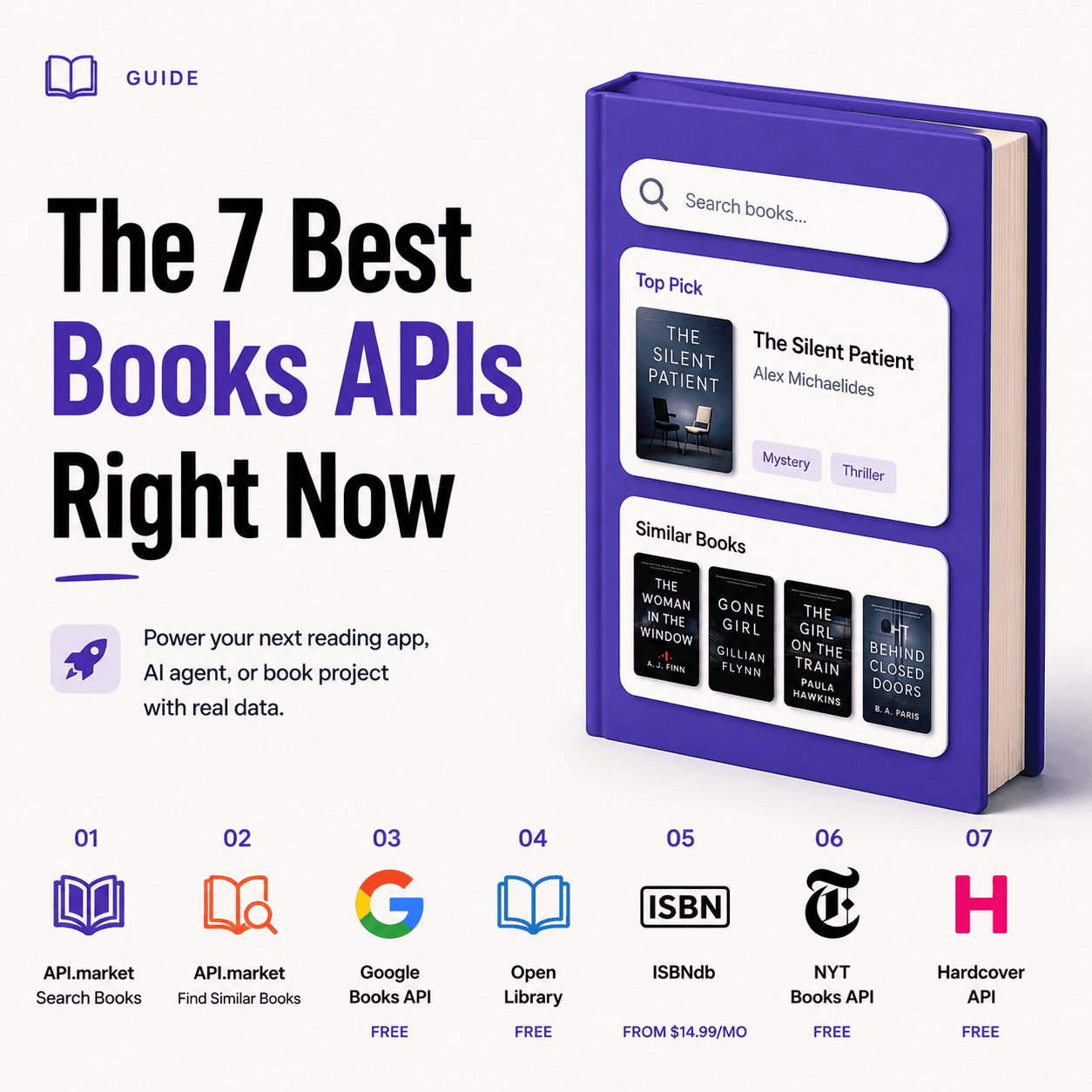
TL;DR: The 7 Best Books APIs in 2026
If you only have 30 seconds, here are the picks.
- API.market Search Books (by Skycraft) is our top pick for most teams. 4 million plus books, semantic search, free 1,500 calls a month, and paid plans from $7/month.
- API.market Find Similar Books is the recommendation companion to Search Books. Same pricing, same free tier.
- Google Books API is the household name. Free with a daily quota.
- Open Library is fully free and covers 20 million plus records. Best for non-commercial and archival work.
- ISBNdb is the specialist for deep ISBN metadata. Starts at $14.99 a month.
- New York Times Books API gives you weekly bestseller lists and reviews. Free with a 1,000 requests a day cap.
- Hardcover API is the modern GraphQL option. Free, community-driven, feels like a Goodreads alternative.
Now the full breakdown.
What is a books API?
A books API is a service that returns clean, structured book data (titles, authors, ISBNs, covers, descriptions, ratings, similar titles) so your app does not have to scrape or hard-code it.
That is the short answer. The longer one is that book APIs come in three broad shapes.
Search APIs let you look up books by title, author, or ISBN. Metadata APIs give you deep record-level details for a single ISBN.
Recommendation APIs return similar or related titles based on a book you already know.
Some services do one job well. Others give you all three under a single key. Your pick depends on what you are building and how much you plan to scale.
Why you need a books API in 2026
Book apps and AI reading agents need real data
Reading apps, AI book agents, ed-tech tools, and book club dashboards all live and die by the quality of their book data.
Try to hard-code it and you break the moment a user searches for something you did not plan for. Try to scrape Amazon and you get banned. Try to prompt an LLM for book data and you get hallucinated titles and made-up ISBNs.
A real books api gives you a stable source of truth. You hit an endpoint, you get clean JSON back, you move on with your day.
What to look for in a book search api
Before you pick one, run through this checklist.
- Catalog size and how fresh the data is. A million titles from 2015 is not useful in 2026.
- Search quality. Can you search by title, ISBN, author, and natural language? Or only exact matches?
- Recommendation quality. Does it return real "similar books" or just other titles by the same author?
- Pricing model. Fixed monthly plans, pay per call, or free with a hard cap?
- Rate limits. Some APIs cap you at 1 request a second, which kills any app with a burst of users.
- Output format. Clean JSON with real fields, not a scraped mess.
- Docs. If the getting-started page confuses you in five minutes, imagine debugging at 2 a.m.
Keep this list open when you evaluate. It saves you from switching vendors two months into a build.
Top 7 Books APIs of 2026
1. API.market Search Books API (by Skycraft)
API.market Search Books indexes over 4 million books with semantic search, filters, and sorting. It is priced free at 1,500 calls a month and scales to 1.5 million calls a month for $199.
This is the search endpoint most teams should start with in 2026. It runs on the same Skycraft engine that powers bigbookapi.com, but ships through the API.market marketplace. That means one API key that also unlocks 500 plus other APIs on the same account.
You search by query text, ISBN, author ID, rating, publication year, or theme. The semantic tagging means natural-language queries actually work. A search for "cozy mystery set in a bakery" returns real cozy mysteries, not a random keyword match.
Key features:
- Catalog of over 4 million books, updated regularly
- Semantic search that understands synonyms and related terms
- Filter by ISBN, author ID, rating, publish year, and theme
- One GET endpoint (/search-books), no OAuth to fight
- 100 TPS on every plan, including free
- Single API.market key works across Find Similar Books and 500 plus other APIs
Pricing is clean and predictable. The free plan gives you 1,500 API calls a month with no credit card. After that it is $7/month for 15,000 calls (PRO), $39/month for 150,000 calls (ULTRA), and $199/month for 1.5 million calls (MEGA). Overage on paid plans is soft-capped, so a spike does not brick your app. Overage rates go from $0.006 per call on PRO down to $0.002 per call on MEGA.
Real use cases:
You are building a reading app that lets users search by title, author, or ISBN. Search Books gives you a clean book card in under 200 milliseconds and you never touch a scraper.
You run an AI reading agent. A user asks for "a book like Gone Girl but set in Tokyo". You call Search Books with a semantic query and ground the LLM response in real books, so it stops inventing titles.
You are a library or a bookshop building a catalog dashboard. You filter new arrivals by theme, rating, and publish year without writing a single custom index.
Here is what a real call looks like:
curl -X GET "https://api.magicapi.dev/api/v1/skycraft/search-books/search-books?query=cozy+mystery+bakery&min-rating=4" \
  -H "x-magicapi-key: YOUR_API_KEY"
You get back a ranked list of books with titles, authors, ISBNs, cover URLs, ratings, and short descriptions. Cache the response, wire the covers into your UI, and you are shipping.
2. API.market Find Similar Books API (by Skycraft)
API.market Find Similar Books returns recommendations from the same 4 million plus book library. It is priced free at 1,500 calls a month and $7 a month for 15,000 calls.
This is the recommendation companion to Search Books, and the two are meant to be used together. You send a book ID. You get back a list of similar titles based on the same semantic tagging engine that powers search. No vector database. No embeddings pipeline. No maintenance.
Key features:
- Recommendations across the same 4 million plus book library
- Semantic tags rather than only collaborative filtering
- One GET endpoint (/list-similar-books)
- Same pricing structure as Search Books, so budgeting is simple
- Shares the API.market key with Search Books and 500 plus other APIs
- 100 TPS across every plan
Pricing mirrors Search Books. Free gets you 1,500 calls a month, PRO is $7/month for 15,000 calls, ULTRA is $39/month for 150,000 calls, and the top plan is $199/month for 1.5 million calls. Overage rates step down as you go up, from $0.006 per call on PRO to $0.002 per call at the top.
Real use cases:
You run a bookshop and want a "readers who liked this also read" carousel on every product page. You call Find Similar Books once per page view, cache the result for 24 hours, and you get a real recommendation strip that lifts your add-to-cart rate.
You are shipping an AI reading agent. You want it to pitch five books that feel like the user's last favorite. You call Find Similar Books, feed the top five titles into your prompt, and ask the model to write a short pitch for each. The model has real books to work with, so the output stops being fiction.
You send weekly email picks to your reading community. You pull the last book each subscriber logged, call Find Similar Books, and personalize the email. That is one background job, not a full recommender team.
Pair Search Books with Find Similar Books and you have a full read-and-recommend stack under one bill.
3. Google Books API
Google Books API is free with a default per-project daily quota and covers millions of titles across Google's global catalog.
This is the default first stop for most developers. It is free, it is Google, and the catalog is deep. The trade-offs are real though. Quotas are strict, the API surface is dated, and the response schema is verbose.
Key features:
- Volume search by title, author, ISBN, or keyword
- Embedded Viewer for book previews on your own site
- User bookshelves through OAuth 2.0
- JSON responses across a huge global catalog
- Free to use with a Google Cloud project
Pricing is free, but you share a default daily quota with the rest of your project. The commonly-quoted cap is around 1,000 requests a day, and quota bumps require a Google Cloud request that is not guaranteed. There is no paid tier you can just click and buy.
Real use cases:
You are building a hobby project that will never cross the daily cap. Google Books works fine and costs you nothing.
You want book preview embeds on an educational site. The Embedded Viewer is a one-liner.
You are building a signed-in reading tracker and want users to save books to their personal Google bookshelf. OAuth flows in cleanly.
Push it into production for a real app with real users though, and the quota bites fast.
4. Open Library API
Open Library API is fully free, covers over 20 million book records, and rate-limits identified requests at 3 per second.
This is the go-to free option for archival, academic, and non-commercial projects. It is run by the Internet Archive and it is a genuine public good. The catalog is great for historical and public-domain titles, and weaker on fresh 2026 bestsellers.
Key features:
- Search, Works, Editions, Authors, Covers, Subjects, and Lists endpoints
- Over 20 million records with a clear Works vs Editions split
- Append .json, .yml, or .rdf to almost any URL for structured data
- No API key required, and identified requests get 3 times the rate limit
- Free with no plans or upgrades
Pricing is $0. There is nothing to buy. The team is explicit that the API is not built for bulk backends, so if you want to sync 10 million records overnight, this is not the right home.
Real use cases:
You are building a classics reading app or an academic literature tool. Open Library has the coverage you want.
You run a community book club site and you never cross commercial scale. Open Library keeps you fully free.
You need cover-image lookups for public-domain titles. Open Library's Covers endpoint is the simplest way to get them.
5. ISBNdb API
ISBNdb covers over 110 million book records. Pricing starts at $14.99/month for 5,000 daily searches and goes up to $99.99/month for 50,000 daily searches on the Pro plan.
This is the specialist for deep ISBN metadata. If your app lives and dies by ISBN lookups, real-time pricing, and cross-region editions, this is the one.
Key features:
- 110 million plus records
- Endpoints for Books, Authors, Publishers, Subjects, Search, and Feed
- Real-time book pricing on the Pro plan
- Up to 19 data points per book
- Rate-limit headers so you can monitor cleanly
Pricing starts at $7.50/month for Academic, while the Basic plan costs $14.99/month for 5,000 daily searches and goes up to $99.99/month for Pro with 50,000 daily searches. Paid plans come with a 7-day free trial, and annual billing saves around 15%.
For larger teams, Enterprise pricing is custom, with search limits and rate limits tailored to your needs.
Real use cases:
You run a used-book resale app and you need real-time pricing per ISBN. ISBNdb Pro is one of the few APIs that ships that.
You maintain a library management system with cross-region edition data. ISBNdb handles the edition sprawl.
You run a catalog cleanup tool that fills gaps in an internal database. Point it at ISBNdb and let it enrich.
6. New York Times Books API
New York Times Books API is free with a 1,000 requests a day cap and gives you weekly bestseller lists and book reviews.
This is the best free source for curated bestseller data and editorial reviews. It is not a general search API and it is not meant to be your only source. But if you want the NYT bestseller list on your homepage, this is the endpoint.
Key features:
- Weekly bestseller lists with ISBNs and rankings
- Book reviews searchable by ISBN, title, or author
- Historical bestseller data going back to June 2008
- JSON or JSONP responses
- Free with an NYT developer key
Pricing is free. You get 1,000 requests a day and 5 requests a minute. Register once at developer.nytimes.com and you have a key.
Real use cases:
You are building a "trending books" widget for a homepage. NYT bestseller data is the credible source.
You run a bookstore site and want to surface an NYT review next to a title. One API call per book, cached for a week.
You are a data-viz person and you want a clean dataset on bestseller trends over 17 years. NYT Books gives you the raw feed.
7. Hardcover API
Hardcover API is a free GraphQL book API with 5,000 requests a day on the free plan and 50,000 a day for supporters. It is positioned as a modern Goodreads alternative.
This is the newest name on this list and the top pick if you like GraphQL and you want a Goodreads-alternative community feel. It uses Personal Access Tokens for auth, and it is the same API the Hardcover website, iOS app, and Android app run on.
Key features:
- GraphQL schema, one flexible endpoint
- Books, authors, editions, series, user libraries, reading progress, reviews
- Same API that powers Hardcover's own apps
- Personal Access Tokens with scoped permissions
- Free to use
Pricing is free. The free plan gives you 5,000 requests a day, 60 a minute, and a burst limit of 10. A paid Hardcover Supporter subscription lifts the cap to 50,000 a day. One request can carry up to 5 top-level queries.
Real use cases:
You are building a personal reading tracker and you want reading-progress sync out of the box. Hardcover handles it.
You run a book club app with shared reviews and lists. Hardcover's schema maps cleanly.
You are migrating users off Goodreads. Hardcover is one of the few APIs that gives you a matching data shape without a rebuild.
Books API Pricing Overview
Here is the fast version of what everything costs.
- API.market Search Books: free at 1,500 calls a month, then $7, $39, or $199 a month.
- API.market Find Similar Books: same as Search Books.
- Google Books API: free with a small daily quota.
- Open Library: fully free.
- ISBNdb: from $14.99 a month, 7-day trial on paid plans.
- New York Times Books API: free, 1,000 requests a day cap.
- Hardcover API: free, 5,000 requests a day on the free tier.
Which books API should you pick in 2026?
If you want the shortest answer: start with API.market's Search Books and Find Similar Books together.
You get 1,500 free calls a month on each, one API key that unlocks 500 plus other APIs on the same account, semantic search out of the box, and a paid PRO plan at $7 a month that beats every other paid entry price on this list. The two APIs pair cleanly, so you never spin up your own recommendation stack.
Two honest sidebars though.
If you know your project will never cross Google's daily quota, Google Books gets you shipping with zero setup and zero cost. Use it for hobby work and student projects.
If your app is enterprise-grade and you need real-time ISBN pricing or cross-region edition data, ISBNdb Pro at $99.99 a month is the fit. It is not the same product category as the marketplace APIs.
For everyone else, get an API.market key, try Search Books and Find Similar Books on the free tier this week, and see how they feel in your codebase.
- Try Search Books: https://api.market/store/skycraft/search-books
- Try Find Similar Books: https://api.market/store/skycraft/list-similar-books
FAQs about books APIs
Q1. What is the best free books API in 2026?
The best free books API in 2026 for most projects is API.market's Search Books, which gives you 1,500 free calls a month across a 4 million plus book catalog with semantic search. Google Books is free with a daily quota, Open Library is fully free for non-commercial use, and Hardcover offers 5,000 free GraphQL requests a day. Your pick depends on scale and use case.
Q2. Is the Google Books API free?
Yes, the Google Books API is free to use, but every project shares a default daily quota (commonly around 1,000 requests a day) that can be raised on request through the Google Cloud Console. Quota bumps are not guaranteed, so production apps often outgrow it. If you need predictable limits, switch to API.market Search Books or ISBNdb.
Q3. How do I get book recommendations with an API?
The simplest way to get book recommendations with an API is to call a purpose-built endpoint like API.market's Find Similar Books, which returns similar titles from a 4 million plus library based on a book ID. Google Books and Open Library do not offer a native similar-books endpoint, so rolling your own would need a vector store, embeddings, and ongoing tuning.
![Featured image for article: Stock Data API: 5 Best Market Data APIs Compared (Pricing & Features) [2026]](/_next/image?url=https%3A%2F%2Fblog.api.market%2Fwp-content%2Fuploads%2F2026%2F06%2Fbest-movie-apis.png&w=3840&q=75)