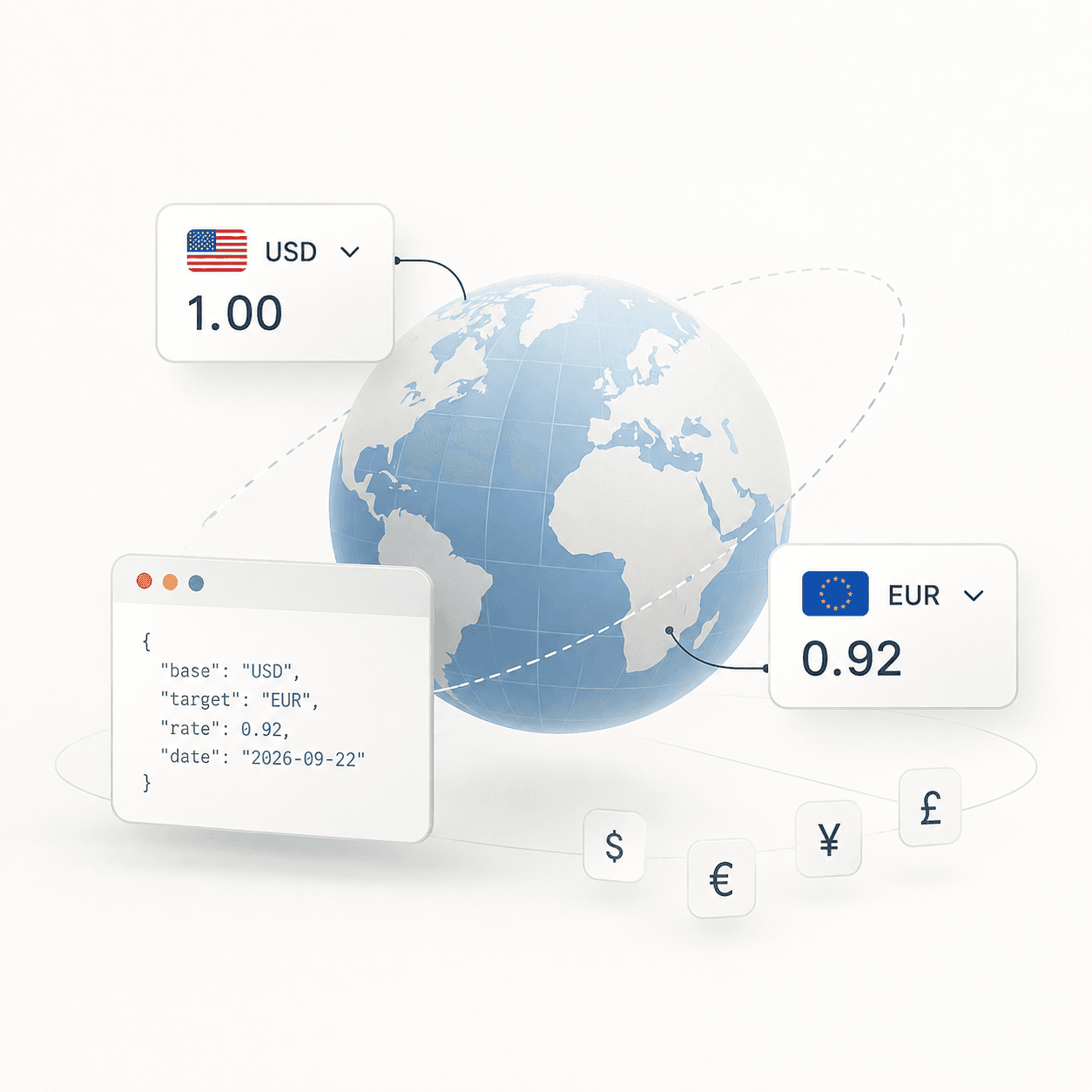
You need exchange rates in your app.
You search for an exchange rate api and find a GitHub repo that got taken down last year, three APIs with 100-call free tiers, and enterprise tools that want you to "talk to sales."
All you need is a JSON response with today's USD-to-EUR rate. We tested the options so you can skip the 15-tab research session and pick the right one.
TL;DR: The 7 Best Exchange Rate APIs
If you only have 30 seconds, here are the picks.
- Viv Data Currency Converter API (API.market) is the fastest way to get real-time rates for 160+ currencies. Free tier available, one API key for everything on API.market.
- QuotaLink Country Info API (API.market) bundles exchange rates with country data like population, holidays, and currency info for 200+ countries. Free tier available.
- ExchangeRate-API has been running since 2010. 165 currencies, 1,500 free requests per month, paid plans from $10/month.
- Frankfurter is fully free, open-source, powered by ECB data. 32 currencies, no API key needed.
- Open Exchange Rates covers 200+ currencies with 1,000 free calls per month and hourly updates.
- Fixer supports 170 currencies with historical data. 100 free calls per month, paid from $8/month.
- fawazahmed0/exchange-api (GitHub) is free and open-source with 200+ currencies including crypto. Community-maintained with some reliability concerns.
Now the full breakdown.
Exchange Rate API: Why You Need One in 2026
Currency Conversion in Apps, SaaS, and E-Commerce
If you sell a $49/month plan and a customer in Germany sees the price in USD, you are losing conversions. That is not a guess. Localized pricing increases conversion rates across every study that has measured it.
A currency exchange rate api handles this for you. Your checkout page calls the API, gets the current EUR/USD rate, and shows the customer a price in euros. No manual spreadsheet. No stale rates from last Tuesday.
The same applies to SaaS billing dashboards that show MRR across currencies, travel apps displaying hotel prices in the traveler's home currency, fintech platforms tracking cross-border payments, and payroll tools calculating salaries for international teams.
And it goes beyond pricing. Accounting tools need exchange rates to reconcile international invoices. Analytics dashboards need them to normalize revenue across markets. Payment gateways need them to settle cross-border transactions in real time.
You do not need to build this yourself. You do not need to scrape Google Finance. You call an endpoint, get a number, and move on.
What to Look For in an Exchange Rate API
Before you commit, run through this checklist.
- Update frequency: do you need real-time rates (forex trading, payment processing) or are daily updates fine (reporting dashboards, invoices)? Real-time costs more. Daily is often enough.
- Currency coverage: some APIs cover 32 currencies, others cover 200+. If you only need USD, EUR, GBP, and JPY, a smaller API works. If you serve customers in 50+ countries, you need broader coverage.
- Free tier generosity: 100 calls per month is a demo, not a free tier. Look for at least 1,000 calls per month before paying.
- Pricing model: some charge per API call, others charge a flat monthly fee. Know your expected call volume before signing up, or you will overpay.
- Historical data: if you need past exchange rates for reporting or compliance, not every API includes this. Some lock it behind paid plans.
- Authentication complexity: some APIs need OAuth flows and token refreshes. Others take a single API key in the header. Simpler is better for most use cases.
- Reliability and uptime: if your checkout flow depends on this API, you need something with redundancy. A solo developer's GitHub project is not that.
- Documentation quality: if you cannot figure out the API in five minutes, imagine debugging it at 2 a.m.
Keep this list open as you read the reviews below. It makes the decision faster.
One more thing. A lot of developers default to whatever free exchange rate api shows up first in a Google search. That works until it does not. Free tiers expire, rate limits kick in during traffic spikes, and solo-maintained open-source projects go offline without warning. Pick based on what your app actually needs six months from now, not what is easiest to set up today.
Top 7 Exchange Rate APIs of 2026
1. Viv Data Currency Converter API (API.market)
This is the simplest currency converter api on the list. You get real-time exchange rates across 160+ global currencies through a clean RESTful endpoint. No OAuth, no token refreshes, no dashboard setup. You grab an API key from API.market, add it to your header, and start converting currencies.
What makes this one different from standalone exchange rate APIs is the API.market ecosystem. The same API key you use here works across 500+ other APIs on the platform. If you are already using API.market for anything else, you do not need a separate account or billing setup.
Key features:
- Real-time exchange rates covering 160+ currencies worldwide
- RESTful API returning clean JSON responses
- API key authentication via the x-api-market-key header, no OAuth required
- One API key unlocks 500+ other APIs on the same API.market account
- Free tier for testing and small-scale projects
- Live conversion endpoint for direct currency-to-currency calculations
The free tier lets you test everything before you pay. After that, pricing scales based on API units. Check the Viv Data Currency Converter page on API.market for current plan details and pricing.
Here is a real API call:
curl -X GET "https://api.market/api/currency-converter?from=USD&to=EUR&amount=100" \
-H "x-api-market-key: YOUR_API_MARKET_KEY"
And the same thing in JavaScript:
fetch("https://api.market/api/currency-converter?from=USD&to=EUR&amount=100", {
headers: {
"x-api-market-key": "YOUR_API_MARKET_KEY"
}
})
.then(res => res.json())
.then(data => console.log(data));
That is it. One call, one header, one response.
You would use this for an e-commerce store converting product prices to the buyer's local currency at checkout. Or a SaaS billing dashboard showing monthly revenue in multiple currencies for a distributed team. Or a travel booking app displaying hotel prices in the traveler's home currency instead of the hotel's local rate.
If you need exchange rates and nothing else, this is where I would start. The API.market ecosystem is the real advantage here. You are not signing up for a standalone service. You are getting access to a marketplace where one key and one billing account covers currency conversion, country data, URL shortening, AI tools, and hundreds of other APIs. That simplifies your vendor management significantly if you are building anything beyond a single-feature app.
2. QuotaLink Country Info API (API.market)
This one takes a different angle. Instead of giving you just exchange rates, the QuotaLink Country Info API bundles rates with broader country data for 200+ countries. One API call gets you the exchange rate, population, official currency, public holidays, and a Wikipedia summary for any country.
That sounds like a lot, but think about what you are actually building. A travel app does not just need the EUR-to-USD rate. It needs to show the destination country's currency name, whether there is a public holiday next week, and what the local tipping customs are. A compliance tool needs to map currencies to countries with population and economic context. This API gives you all of that in one request instead of stitching together three or four separate services.
Key features:
- Exchange rates bundled with country-level data for 200+ countries
- Population, currency name, public holidays, and Wikipedia summaries in a single call
- Covers travel, compliance, international HR, and business intelligence use cases
- RESTful API available through API.market
- Same API key as every other API.market product
- Free tier for development and testing
Pricing scales through API.market's unit-based system. Visit the QuotaLink Country Info API page for the latest pricing details.
Real scenarios where this fits: a travel app showing the destination's currency, current exchange rate, and upcoming public holidays on one screen.
An international payroll tool that needs exchange rates and country-specific holiday calendars to calculate PTO correctly. A market research dashboard mapping currencies to countries with population and GDP context.
If your app needs exchange rates plus country context, this API saves you from calling two or three endpoints and merging the data yourself. Most exchange rate APIs give you a number. This one gives you the number plus the context around it. That is a meaningful difference when you are building for international users who need more than just a converted price tag.
3. ExchangeRate-API
ExchangeRate-API is one of the oldest players in this space. It has been running since 2010, and some of its original endpoints still work today. That kind of stability matters when you are building something that needs to run for years without you touching the integration.
It covers 165 currencies across 200 countries. The data comes from a blend of central bank rates and commercial sources, which gives you more accurate mid-market rates than APIs that rely on a single source.
Key features:
- 165 currencies across 200 countries with blended data sources
- Free tier gives you 1,500 requests per month with daily rate updates
- Paid plans start at $10/month (Pro) with hourly updates and go up to $30/month (Business) with 5-minute updates
- Reports 99.99% uptime backed by redundant AWS infrastructure
- Endpoints are never deprecated for paying customers
The free plan gives you 1,500 requests per month with daily updates. The Pro plan costs $10/month and bumps you to 30,000 requests with hourly updates. The Business plan is $30/month with 125,000 requests and rates that refresh every 5 minutes. Yearly billing saves you 2 months.
You would use ExchangeRate-API for internal dashboards tracking international sales in a single base currency. Or academic research projects that need daily exchange rate snapshots over time. Or spreadsheet models that pull live forex data through a simple GET request.
A solid pick if you want a proven, long-running service with a generous free tier.
4. Frankfurter
Frankfurter is the API you use when you want zero friction. No API key. No signup. No rate limits. You call the endpoint, and you get exchange rates sourced from the European Central Bank.
The trade-off is coverage. Frankfurter supports 32 major fiat currencies. No crypto. No metals. No exotic currencies. If you need USD, EUR, GBP, JPY, CAD, AUD, and the other big ones, it works perfectly. If you need the Thai Baht or Nigerian Naira, look elsewhere.
Key features:
- Completely free with no API key, no signup, and no rate limits
- Data sourced directly from the European Central Bank (ECB)
- 32 major fiat currencies supported
- Historical data available going back to ECB's data start date
- Open-source, so you can self-host if you want full control
Pricing is simple: free. There are no paid tiers. No premium features locked behind a paywall. It is open-source and funded as a public resource.
This is the free exchange rate api you reach for when building a side project, an MVP, or an educational tool. If your app does not need 100+ currencies and you want to skip the signup process entirely, Frankfurter gets you moving in under a minute.
Not the pick for production apps that need broad currency coverage or real-time updates. ECB data refreshes once per business day.
5. Open Exchange Rates
Open Exchange Rates is popular in the Node.js and Ruby ecosystems. It covers 200+ currencies including some crypto, and the free tier gives you 1,000 requests per month with hourly updates.
The free plan restricts you to USD as the base currency. If you need EUR or GBP as your base, you will need the Developer plan at $12/month.
Key features:
- 200+ currencies including select cryptocurrencies
- Free tier at 1,000 requests per month with hourly updates (USD base only)
- Developer plan at $12/month unlocks all base currencies and 10,000 requests
- Historical data and time-series queries on paid plans
- Well-maintained open-source client libraries for Node.js and Ruby
The free plan works for side projects and internal tools where USD is your base. The Developer plan at $12/month is where most production apps land. Enterprise pricing starts at $97/month with 100,000 requests and priority support.
Good for startups testing international pricing before committing to a bigger service. The npm package makes Node.js integration particularly fast.
6. Fixer
Fixer has been around for years and is now owned by APILayer. It supports 170 currencies with data sourced from the ECB and 15+ commercial providers.
The standout feature is historical data: you can pull exchange rates from specific dates going back decades.
The free tier is tight, though. You get 100 calls per month, EUR as the only base currency, and no HTTPS. Yes, the free plan sends your API key over plain HTTP. That is a dealbreaker for anything in production.
Key features:
- 170 currencies with data from ECB and 15+ commercial data providers
- Historical rates, fluctuation data, and time-series endpoints
- 256-bit SSL encryption on paid plans
- 100 free calls per month (EUR base only, HTTP only)
- Paid plans from $8/month with HTTPS and all base currencies
The Basic plan at $8/month gets you HTTPS, all base currencies, and 10,000 requests. The Professional plan at $26/month adds historical and fluctuation endpoints with 100,000 requests. Enterprise pricing is custom.
You would use Fixer for financial reporting dashboards that need historical rate lookups. Or fintech apps tracking currency fluctuations over specific time windows. The historical data depth is where Fixer earns its spot on this list.
7. fawazahmed0/exchange-api (GitHub)
This is the community favorite. A free, open-source exchange rate api hosted on jsDelivr and Cloudflare CDN. No API key needed. No rate limits. 200+ currencies including major crypto like BTC and ETH, plus precious metals.
The catch: it is maintained by one person. And there is a well-known Reddit thread in r/webdev where developers discussed GitHub temporarily removing the repository. The repo is back and active with 2.6k stars and regular updates, but that incident raised real concerns about depending on it for production workloads.
Key features:
- Completely free with no API key and no rate limits
- 200+ currencies including crypto (BTC, ETH) and precious metals
- Hosted on jsDelivr and Cloudflare CDN for fast global responses
- Daily updates with historical data support
- Open-source with 2.6k GitHub stars and 220 forks
Pricing: free. Open-source. No paid tiers exist.
Use this for hobby projects and prototypes where uptime guarantees do not matter. Crypto portfolio trackers that need fiat and crypto rates from one source. Developers who want to fork the project and self-host their own version.
I would not build a production checkout flow on this. But for a weekend project or a proof of concept, it is hard to beat free with no signup.
How to Integrate an Exchange Rate API
If you have never called a currency conversion api before, here is how it works. You send a GET or POST request to the API endpoint, pass your base currency and target currency, and get a JSON response with the converted amount or the exchange rate.
Here is a quick example using the Viv Data Currency Converter API on API.market.
With curl:
curl -X GET "https://api.market/api/currency-converter?from=USD&to=INR&amount=500" \
-H "x-api-market-key: YOUR_API_MARKET_KEY"
With Python:
import requests
url = "https://api.market/api/currency-converter"
params = {"from": "USD", "to": "INR", "amount": 500}
headers = {"x-api-market-key": "YOUR_API_MARKET_KEY"}
response = requests.get(url, params=params, headers=headers)
data = response.json()
print(data)
With JavaScript (fetch):
const response = await fetch(
"https://api.market/api/currency-converter?from=USD&to=INR&amount=500",
{
headers: {
"x-api-market-key": "YOUR_API_MARKET_KEY"
}
}
);
const data = await response.json();
console.log(data);
Three languages. Same pattern. One header, one endpoint, one JSON response. You can have a working currency converter running in under five minutes.
The pattern works the same way for the other APIs on this list. Frankfurter does not even need a header since it requires no API key.
ExchangeRate-API and Open Exchange Rates use query parameter authentication instead of a header. The structure is always the same: call the endpoint, pass your currencies, parse the JSON. Once you have done it once, switching between providers takes about ten minutes of code changes.
Pricing Overview
Here is the cost picture across all seven APIs.
- Viv Data Currency Converter API (API.market): free tier available. Paid plans scale by API units. See api.market/store/viv-data/currency-converter for current pricing.
- QuotaLink Country Info API (API.market): free tier available. Paid plans scale by API units. See api.market/store/quotalink/country-info-api for current pricing.
- ExchangeRate-API: free at 1,500 req/month. Pro is $10/month. Business is $30/month. Yearly billing saves 2 months.
- Frankfurter: completely free. No paid tiers.
- Open Exchange Rates: free at 1,000 req/month (USD base only). Developer is $12/month. Enterprise is $97/month.
- Fixer: free at 100 req/month (EUR base, no HTTPS). Basic is $8/month. Professional is $26/month.
- fawazahmed0/exchange-api: completely free. Open-source.
Conclusion
Seven exchange rate APIs, each built for a different use case. For most developers, the Viv Data Currency Converter API on API.market is the fastest starting point: 160+ currencies, a free tier, and one API key that works across 500+ other APIs.
If your app needs exchange rates bundled with country data like holidays and population, the QuotaLink Country Info API handles that in a single call. ExchangeRate-API and Frankfurter are strong alternatives if you want a long-running service or a fully free option with no signup.
FAQs About Exchange Rate APIs
1. Is there a free exchange rate API?
Yes, several exchange rate APIs offer free tiers. Frankfurter is completely free with no API key, no signup, and no rate limits, though it only covers 32 currencies. ExchangeRate-API gives you 1,500 free requests per month. The fawazahmed0/exchange-api on GitHub is free and open-source with 200+ currencies. Viv Data on API.market also offers a free tier. Free plans typically update daily and have lower request limits than paid plans.
2. What is the best exchange rate API for developers?
The best exchange rate API depends on your use case. For most projects needing broad currency coverage, the Viv Data Currency Converter API on API.market covers 160+ currencies with a single API key. For simple EUR-based projects, Frankfurter works with zero setup. For enterprise use cases needing historical data and high uptime, ExchangeRate-API or Fixer are reliable options with long track records.
3. How do I make a currency converter in Python with an API?
You can build a Python currency converter by calling any REST-based exchange rate API using the requests library. Import requests, send a GET request to the API endpoint with your base currency, target currency, and amount as parameters, then parse the JSON response for the converted value. See the code examples section above for a working implementation using the Viv Data Currency Converter API.
4. Does Google have a currency exchange rate API?
Google does not offer a public currency exchange rate API for developers. Google Finance shows exchange rates in search results, but there is no official REST endpoint you can call. The GOOGLEFINANCE function works in Google Sheets but is not available as an API. For programmatic access, use alternatives like the Viv Data Currency Converter on API.market, ExchangeRate-API, or Frankfurter.
5. Is the Frankfurter API free?
Yes, Frankfurter is completely free with no API key, no signup, and no rate limits. It pulls exchange rate data from the European Central Bank and supports 32 major fiat currencies. The limitation is coverage: no crypto, no precious metals, and no exotic currencies. Rates update once per business day. It is a solid pick for simple projects but not for apps needing 100+ currencies or real-time data.