5 Best API for Stock Market Data All Over the World [2026]

Discover the 5 best stock market APIs for data all over the world in 2026, including Polygon.io, Yahoo Finance, Alpha Vantage, IEX Cloud, and Quandl. Compare features, pricing, and real-time data to power your trading and analytics.

Author: Aditi Upadhyay

Published: 2026-04-13T00:00:00.000Z

Updated: 2026-04-12T20:17:36.078Z

Categories:FinanceData
Tags:APIsStock MarketFinancial Technology

You're building something that depends on accurate, fast stock data. 


Maybe a trading bot, a portfolio tracker, or a fintech dashboard. And now you're stuck figuring out which stock market data API is actually worth your time and money. 


This guide covers the 5 best options for 2026, with real pricing, honest trade-offs, and a clear verdict on each.


Introduction to Stock Market Data APIs


A stock market data API is a service that gives you programmatic access to financial data. You send a request, and it sends back prices, historical data, company fundamentals, or whatever you asked for.


You don't have to scrape anything. You don't have to maintain a data pipeline from scratch. The API handles that and delivers structured JSON you can plug straight into your app.


What you're really paying for is reliability. The data has to be accurate, the uptime has to hold, and the latency has to be low enough that your app doesn't fall behind live markets.


Before we get into the details, here is every stock market data API we cover in this guide:

  1. Polygon
  2. Yahoo Finance 
  3. Alpha Vantage
  4. Finnhub
  5. Quandl


Types of Stock Market Data APIs


Not every stock API covers the same ground. Before you pick one, it helps to know what category of data you actually need.


Financial Market API


This is the broadest category. A financial market API gives you equity prices, indices, currency exchange rates, and sometimes commodities all in one place. If you're building anything that spans multiple asset classes, this is what you want.


Trading Data API


A trading data API focuses on speed. It's built for low-latency access to real-time trades and quotes, often delivered through WebSocket streams. If you're running any kind of algorithmic or automated trading system, the milliseconds matter here.


Investment Data API


An investment data API leans toward fundamentals. Think earnings reports, balance sheets, analyst ratings, dividend histories, and price-to-earnings ratios. These are the tools for long-term portfolio analysis and research rather than real-time execution.


Market Intelligence API


A market intelligence API goes beyond price data. It might include sentiment scores, news feeds, economic indicators, and macroeconomic datasets. Think of it as the layer that helps you understand why prices are moving, not just what they're doing.


5 Best API for Stock Market Data All Over the World


1. Polygon.io


Start here if you're building anything serious in the US markets. Polygon.io is one of the most complete stock market data APIs available

right now, and you can access it directly through API.market.


You get real-time data streamed through WebSockets with sub-20ms latency, plus full REST access for historical queries. The coverage spans all US exchanges, dark pools, and OTC markets. Not just the major exchanges. All of them.


What makes Polygon.io stand out is the depth. You can pull live trades, quotes, last sale prices, aggregate bars, and reference data from a single provider. Stocks, options, forex, crypto, and futures are all covered under the same account.


Features:

  • Real-time WebSocket streaming for trades and quotes (under 20ms latency)
  • REST API for historical OHLCV data and aggregates
  • Full US market coverage including dark pools and OTC markets
  • Options chain data with Greeks
  • Forex and cryptocurrency data included
  • S3 flat file access for bulk historical downloads
  • Official MCP server integration for AI agent workflows
  • 28 total endpoints covering all major data types


Pricing (via API.market):

  • Free Trial: $0 - 7-day trial, 100 API units, no credit card required
  • Pro: $29/month - 1,000,000 API units/month, 28 endpoints, hard limit
  • Ultra: $79/month - 5,000,000 API units/month, 28 endpoints, hard limit
  • Mega: $199/month - 12,000,000 API units/month, 28 endpoints, hard limit


Worth flagging: the free trial gives you 100 calls to test with. After that you need a paid plan. Unused API units reset at the end of each billing cycle.


Ideal for: Developers building trading apps, fintech dashboards, or AI-powered market tools that need institutional-grade US equity and options data.


2. Yahoo Finance via API.market


This is the easiest way to get broad global stock data without spending much. The Yahoo Finance API on API.market wraps Yahoo's financial data into a clean, reliable endpoint you can call straight from your code.


Yahoo Finance covers thousands of tickers across global markets. US stocks, international equities, ETFs, mutual funds, indices, currency pairs, cryptocurrencies, and more. It's probably the widest coverage-to-cost ratio of anything on this list.


You're not dealing with the fragility of scraping Yahoo Finance yourself or relying on unofficial Python wrappers that break when Yahoo changes their internal structure.


The API.market version gives you a stable, documented endpoint with proper authentication and rate limits. With 79 endpoints, it covers everything from real-time quotes and options chains to earnings calendars and insider ownership data.


Features:

  • Global stock coverage across US, European, Asian, and emerging markets
  • Real-time quotes and intraday data for stocks, ETFs, crypto, and indices
  • Historical price data with customizable intervals and periods
  • Company fundamentals: P/E ratio, EPS, revenue, balance sheets, cash flow
  • Earnings dates, analyst recommendations, and price targets
  • Options chains for derivatives analysis
  • Stock screeners and market movers tracking
  • Dividend history and upcoming dividend events
  • Market news, trending symbols, and IPO calendar
  • 79 total endpoints in clean, structured JSON


Pricing (via API.market):

  • Free Trial: $0 - 7-day trial, 10 API units, no credit card required
  • Pro: $12.99/month - 5,000 API units/month, 79 endpoints, hard limit
  • Mega: $59.99/month - 50,000 API units/month, 79 endpoints, hard limit
  • Ultra: $199.99/month - 30,000 API units/month, 79 endpoints, hard limit

Ideal for: Developers and analysts who need wide global coverage at accessible pricing, and anyone building portfolio trackers, watchlist apps, or earnings research tools.


3. Alpha Vantage


Alpha Vantage is the go-to option when you need pre-built technical indicators alongside your price data. Instead of pulling raw OHLCV and calculating RSI or MACD yourself, Alpha Vantage returns them ready to use.


The free tier covers 25 API requests per day, which is genuinely enough to prototype and test. The paid plans unlock higher request limits and additional data types.


What's new in 2026 is the native MCP server compatibility. If you're building AI agents that need to query time-series market data contextually, Alpha Vantage plugs in directly without you needing to build a custom integration layer.


Features:

  • 200,000+ global tickers across 20+ exchanges
  • 50+ pre-built technical indicators (RSI, MACD, Bollinger Bands, and more)
  • 20+ years of historical data
  • Real-time and intraday data for US equities
  • Forex, crypto, ETF, mutual fund, and commodities data
  • Economic indicators including GDP, inflation, and unemployment rates
  • Native MCP server for AI and LLM integration


Pricing:

  • Free: $0 - 25 requests/day
  • Plan 30: $49.99/month - 75 requests/min
  • Plan 120: $149.99/month - 300 requests/min
  • Plan 360: $399.99/month - 600 requests/min
  • Enterprise: Custom pricing - unlimited requests


Ideal for: Quantitative analysts, algo traders, and developers building investment tools who want technical analysis data delivered without running their own calculations.


4. Finnhub


Finnhub is the one you reach for when you need real-time data AND sentiment data from the same place. Most stock APIs give you prices. Finnhub gives you prices, news, earnings call transcripts, social sentiment scores, ESG metrics, and supply chain relationships all through a single API key.


What makes Finnhub stand out from the other options on this list is the alternative data layer. If you're building a market intelligence API or a sentiment-driven trading model, you can pull earnings call transcripts, analyst estimate revisions, insider transaction patterns, and economic indicators without stitching together multiple providers.


Features:

  • Real-time US stock prices via REST and WebSocket streaming
  • Free WebSocket streaming for up to 50 symbols simultaneously
  • Global company fundamentals covering 60+ exchanges
  • News sentiment scores and social media monitoring
  • Earnings call transcripts and earnings surprise history
  • SEC filing access and insider transaction tracking
  • ESG data and supply chain relationship data
  • Forex and cryptocurrency price feeds
  • Economic calendar and macroeconomic indicators
  • Official Python and JavaScript SDK support


Pricing:

  • Free: $0 - 60 API calls/minute, real-time US stocks, WebSocket (50 symbols)
  • Starter: $49.99/month - higher rate limits, extended data access
  • Pro: $129.99/month - full fundamentals and alternative data
  • Advanced: $199.99/month - premium data coverage, priority support
  • Enterprise: Custom pricing - starting from $3,000/month for institutional access


Worth flagging: Finnhub's free tier is one of the best on this list for getting started. But if you need full global coverage or want to go beyond US equities, you'll need a paid plan.


Ideal for: Developers building market intelligence tools, sentiment-driven trading systems, or any application that needs alternative financial data alongside standard price feeds.


5. Quandl (Now Nasdaq Data Link)


Quandl has rebranded as Nasdaq Data Link, but most developers still know it by its original name. It's the best option on this list for economic and alternative datasets.


Think futures prices, bond yields, commodity data, and macro indicators alongside stock prices.


The free tier gives you 500 API requests per day, which is genuinely useful. The paid tiers start at $10 per month, making it one of the more affordable options for historical data work.


Nasdaq Data Link returns data in JSON, CSV, and Excel formats. If you're doing research or academic analysis and need financial market data alongside broader economic context in one place, this is the one to have.


Features:

  • Stock prices, indices, ETFs, and futures data
  • Bond yields, interest rates, and macroeconomic indicators
  • Commodity prices covering oil, gold, and agricultural markets
  • Data delivery in JSON, CSV, and Excel formats
  • Extensive alternative datasets for quantitative research


Pricing:

  • Free: $0 - 500 requests/day
  • Bronze: $10/month - higher rate limits
  • Silver: $25/month - higher rate limits
  • Gold: $50/month - higher rate limits
  • Platinum: Custom pricing - enterprise-level access


Ideal for: Researchers, quants, and analysts who need broad economic context alongside equity data, or anyone building models that combine stock prices with macroeconomic variables.


Key Features to Look For


Before you commit to any stock market data API, run it against this checklist. These are the factors that actually determine whether an API holds up in production:


  • Data freshness: Is the data real-time, 15-minute delayed, or end-of-day? This matters a lot for trading tools. Less so for research workflows.
  • Global coverage: If you need data from markets outside the US, confirm which exchanges the API actually supports. Some APIs claim global coverage but only give partial data for non-US markets.
  • Rate limits: Free tiers sound attractive until you hit the ceiling mid-pipeline. Know exactly how many calls you get per minute and per day before you build on top of it.
  • Uptime and reliability: Check independent reviews, not just the provider's own status page. Market hours are the worst time to discover your data provider has reliability issues.
  • Historical depth: For backtesting strategies, you often need 10 to 20 years of clean historical data. Not all APIs offer this at affordable price points.
  • Documentation quality: Poorly documented APIs cost you hours. A clear, maintained reference with working code examples saves you significant integration time.


Comparing Pricing Models and Plans


Here's how all four active APIs stack up side by side:
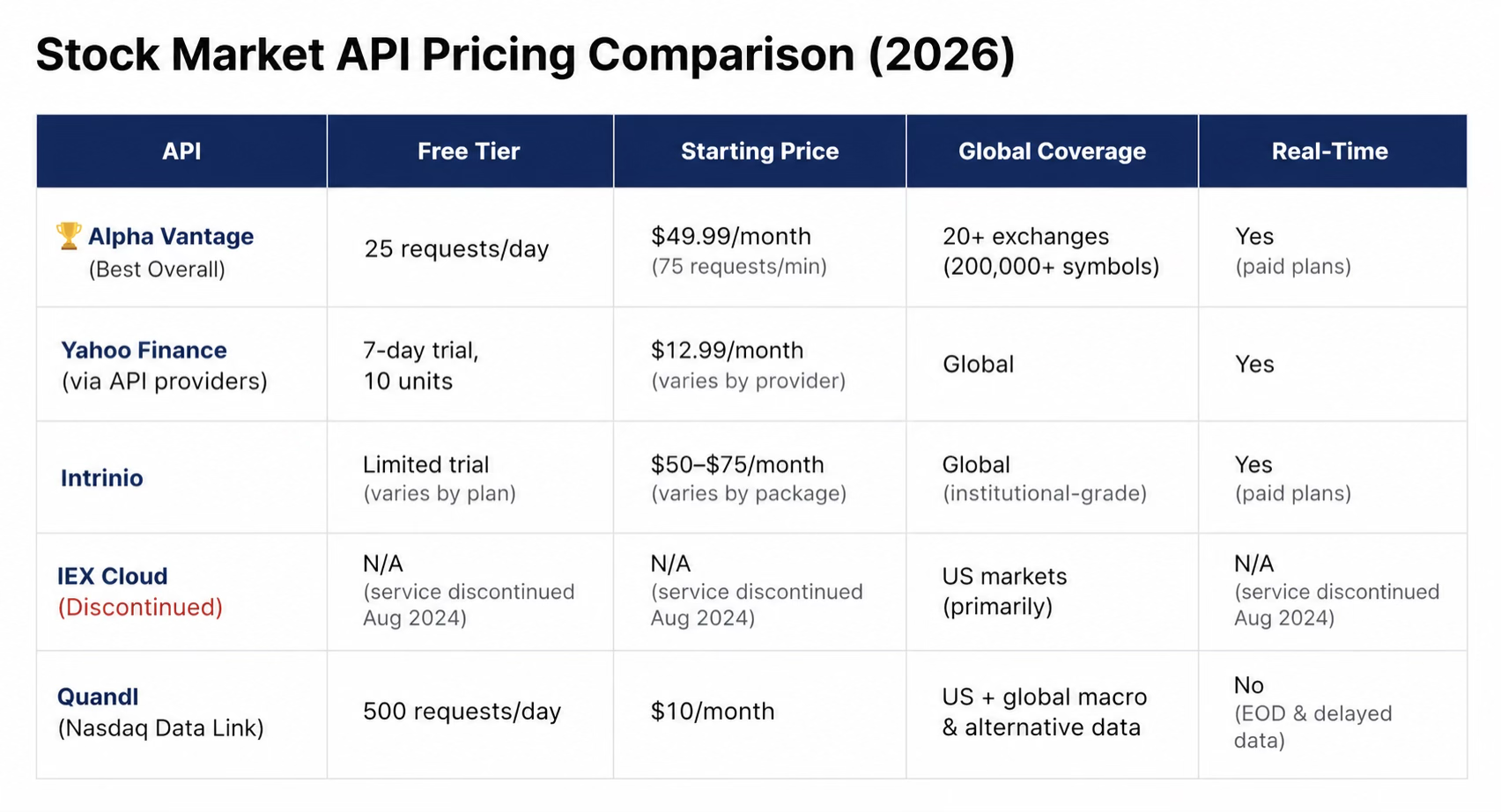


You'll notice a pattern here. Real-time data costs more. If you don't actually need live prices for your use case, you can save significantly by using end-of-day plans for backtesting and research workflows. Yahoo Finance at $12.99/month for global coverage is genuinely hard to beat for early-stage projects.


Use Cases for Stock Market Data APIs


Algorithmic and Automated Trading


You need fast data, clean formatting, and consistent uptime. Polygon.io is the strongest fit here. Its WebSocket streaming and sub-20ms latency make it purpose-built for execution systems where speed matters.


For backtesting a strategy before you go live, historical OHLCV data from any of these APIs works fine. Just make sure you're testing with the same data frequency your live system will use.


Portfolio Tracking and Investment Apps


Yahoo Finance via API.market is a strong starting point for this use case. You get broad coverage across global markets, fundamentals, and dividend data, all from a single provider. The $12.99/month Pro plan keeps costs manageable while you're early and scaling.


Alpha Vantage makes sense here if your app shows technical analysis charts alongside portfolio performance. The pre-built indicators save your backend from running calculations on every data refresh.


Quantitative Research and Backtesting


Nasdaq Data Link's combination of stock prices and macroeconomic datasets makes it well-suited for research. When you're building a model that incorporates both equity returns and economic variables, having both in one API saves you from juggling multiple data sources.


AI Agent and LLM Integration


This is the newest use case, and it's growing fast. Alpha Vantage added native MCP server support in 2026, which means you can connect it directly to an AI agent without building a custom tool layer. Polygon.io also has an official MCP server.


If you're building market-aware AI tools, both are worth evaluating. You can read more about how developers are combining APIs with AI workflows on the API.market blog.


Conclusion


If you're looking for the best api for stock market data all over the world in 2026, start with the two options available on API.market.

Polygon.io on API.market is the right call for anything requiring real-time US market data, tick-level coverage, and WebSocket streaming.


The Pro plan at $29/month gives you 1 million API units and access to all 28 endpoints. For production-grade trading tools, it's the clearest choice on this list.


Yahoo Finance on API.market covers the most ground for the least cost. Global equities, fundamentals, options, earnings, screeners, and news all wrapped in 79 clean endpoints for $12.99/month. If you need wide coverage and fast integration, this one is hard to argue with.


Beyond those two: Alpha Vantage is the one to add when you need pre-built technical indicators and AI-native integrations. Nasdaq Data Link (Quandl) fills the gap for macro and alternative data research.


One thing to flag clearly: IEX Cloud is gone as of August 2024. If you see any guides still recommending it, they're out of date. The APIs above are the active, maintained services worth building on right now.


Explore all available APIs, pricing, and documentation at API.market.


Frequently Asked Questions (FAQ's)


1. What is a stock market data API?


A stock market data API gives you programmatic access to financial data like prices, historical OHLCV values, fundamentals, and technical indicators. You send a request with a ticker symbol and get back structured JSON you can plug straight into your app.


2. How do you choose the best API for stock market data?


Start with what your app actually needs. Real-time trading tools need low-latency WebSocket streams like Polygon.io. Research and backtesting can use cheaper end-of-day data. Then check rate limits, historical depth, and total cost at your expected volume.


3. Are there free stock market data APIs available?


Yes. Polygon.io and Yahoo Finance on API.market both offer 7-day free trials. Alpha Vantage gives 25 free requests per day. Finnhub offers 60 free calls per minute with no expiry. Free tiers work for testing, but production apps usually need a paid plan.


4. How can stock market data APIs enhance trading strategies?


APIs give your strategy real-time prices to trigger entries and exits, technical indicators to confirm signals, and years of historical data for backtesting before risking real capital. A reliable investment data API also removes the burden of maintaining your own data pipeline.


5. What makes Finnhub different from other stock market data APIs?


Finnhub goes beyond price data. Alongside real-time quotes, you get news sentiment scores, earnings call transcripts, ESG metrics, and insider transaction data. It's the strongest option on this list for market intelligence and sentiment-driven applications.


6. What is the difference between a trading data API and an investment data API?


A trading data API delivers real-time prices, trades, and quotes where speed is the priority. An investment data API focuses on fundamentals like earnings, balance sheets, and analyst ratings for longer-term research. Most serious market apps end up needing both.
5 Best API for Stock Market Data All Over the World [2026]

Discover the 5 best stock market APIs for data all over the world in 2026, including Polygon.io, Yahoo Finance, Alpha Vantage, IEX Cloud, and Quandl. Compare features, pricing, and real-time data to power your trading and analytics.
5 Best API for Stock Market Data All Over the World [2026]

You're building something that depends on accurate, fast stock data. 

Maybe a trading bot, a portfolio tracker, or a fintech dashboard. And now you're stuck figuring out which stock market data API is actually worth your time and money. 

This guide covers the 5 best options for 2026, with real pricing, honest trade-offs, and a clear verdict on each.


Introduction to Stock Market Data APIs

A stock market data API is a service that gives you programmatic access to financial data. You send a request, and it sends back prices, historical data, company fundamentals, or whatever you asked for.

You don't have to scrape anything. You don't have to maintain a data pipeline from scratch. The API handles that and delivers structured JSON you can plug straight into your app.

What you're really paying for is reliability. The data has to be accurate, the uptime has to hold, and the latency has to be low enough that your app doesn't fall behind live markets.

Before we get into the details, here is every stock market data API we cover in this guide:

  1. Polygon
  2. Yahoo Finance 
  3. Alpha Vantage
  4. Finnhub
  5. Quandl


Types of Stock Market Data APIs

Not every stock API covers the same ground. Before you pick one, it helps to know what category of data you actually need.


Financial Market API

This is the broadest category. A financial market API gives you equity prices, indices, currency exchange rates, and sometimes commodities all in one place. If you're building anything that spans multiple asset classes, this is what you want.


Trading Data API

A trading data API focuses on speed. It's built for low-latency access to real-time trades and quotes, often delivered through WebSocket streams. If you're running any kind of algorithmic or automated trading system, the milliseconds matter here.


Investment Data API

An investment data API leans toward fundamentals. Think earnings reports, balance sheets, analyst ratings, dividend histories, and price-to-earnings ratios. These are the tools for long-term portfolio analysis and research rather than real-time execution.


Market Intelligence API

A market intelligence API goes beyond price data. It might include sentiment scores, news feeds, economic indicators, and macroeconomic datasets. Think of it as the layer that helps you understand why prices are moving, not just what they're doing.


5 Best API for Stock Market Data All Over the World

1. Polygon.io

Start here if you're building anything serious in the US markets. Polygon.io is one of the most complete stock market data APIs available

right now, and you can access it directly through API.market.

You get real-time data streamed through WebSockets with sub-20ms latency, plus full REST access for historical queries. The coverage spans all US exchanges, dark pools, and OTC markets. Not just the major exchanges. All of them.

What makes Polygon.io stand out is the depth. You can pull live trades, quotes, last sale prices, aggregate bars, and reference data from a single provider. Stocks, options, forex, crypto, and futures are all covered under the same account.

Features:

  • Real-time WebSocket streaming for trades and quotes (under 20ms latency)
  • REST API for historical OHLCV data and aggregates
  • Full US market coverage including dark pools and OTC markets
  • Options chain data with Greeks
  • Forex and cryptocurrency data included
  • S3 flat file access for bulk historical downloads
  • Official MCP server integration for AI agent workflows
  • 28 total endpoints covering all major data types

Pricing (via API.market):

  • Free Trial: $0 - 7-day trial, 100 API units, no credit card required
  • Pro: $29/month - 1,000,000 API units/month, 28 endpoints, hard limit
  • Ultra: $79/month - 5,000,000 API units/month, 28 endpoints, hard limit
  • Mega: $199/month - 12,000,000 API units/month, 28 endpoints, hard limit

Worth flagging: the free trial gives you 100 calls to test with. After that you need a paid plan. Unused API units reset at the end of each billing cycle.

Ideal for: Developers building trading apps, fintech dashboards, or AI-powered market tools that need institutional-grade US equity and options data.


2. Yahoo Finance via API.market

This is the easiest way to get broad global stock data without spending much. The Yahoo Finance API on API.market wraps Yahoo's financial data into a clean, reliable endpoint you can call straight from your code.

Yahoo Finance covers thousands of tickers across global markets. US stocks, international equities, ETFs, mutual funds, indices, currency pairs, cryptocurrencies, and more. It's probably the widest coverage-to-cost ratio of anything on this list.

You're not dealing with the fragility of scraping Yahoo Finance yourself or relying on unofficial Python wrappers that break when Yahoo changes their internal structure.

The API.market version gives you a stable, documented endpoint with proper authentication and rate limits. With 79 endpoints, it covers everything from real-time quotes and options chains to earnings calendars and insider ownership data.

Features:

  • Global stock coverage across US, European, Asian, and emerging markets
  • Real-time quotes and intraday data for stocks, ETFs, crypto, and indices
  • Historical price data with customizable intervals and periods
  • Company fundamentals: P/E ratio, EPS, revenue, balance sheets, cash flow
  • Earnings dates, analyst recommendations, and price targets
  • Options chains for derivatives analysis
  • Stock screeners and market movers tracking
  • Dividend history and upcoming dividend events
  • Market news, trending symbols, and IPO calendar
  • 79 total endpoints in clean, structured JSON

Pricing (via API.market):

  • Free Trial: $0 - 7-day trial, 10 API units, no credit card required
  • Pro: $12.99/month - 5,000 API units/month, 79 endpoints, hard limit
  • Mega: $59.99/month - 50,000 API units/month, 79 endpoints, hard limit
  • Ultra: $199.99/month - 30,000 API units/month, 79 endpoints, hard limit

Ideal for: Developers and analysts who need wide global coverage at accessible pricing, and anyone building portfolio trackers, watchlist apps, or earnings research tools.

3. Alpha Vantage

Alpha Vantage is the go-to option when you need pre-built technical indicators alongside your price data. Instead of pulling raw OHLCV and calculating RSI or MACD yourself, Alpha Vantage returns them ready to use.

The free tier covers 25 API requests per day, which is genuinely enough to prototype and test. The paid plans unlock higher request limits and additional data types.

What's new in 2026 is the native MCP server compatibility. If you're building AI agents that need to query time-series market data contextually, Alpha Vantage plugs in directly without you needing to build a custom integration layer.

Features:

  • 200,000+ global tickers across 20+ exchanges
  • 50+ pre-built technical indicators (RSI, MACD, Bollinger Bands, and more)
  • 20+ years of historical data
  • Real-time and intraday data for US equities
  • Forex, crypto, ETF, mutual fund, and commodities data
  • Economic indicators including GDP, inflation, and unemployment rates
  • Native MCP server for AI and LLM integration

Pricing:

  • Free: $0 - 25 requests/day
  • Plan 30: $49.99/month - 75 requests/min
  • Plan 120: $149.99/month - 300 requests/min
  • Plan 360: $399.99/month - 600 requests/min
  • Enterprise: Custom pricing - unlimited requests

Ideal for: Quantitative analysts, algo traders, and developers building investment tools who want technical analysis data delivered without running their own calculations.


4. Finnhub

Finnhub is the one you reach for when you need real-time data AND sentiment data from the same place. Most stock APIs give you prices. Finnhub gives you prices, news, earnings call transcripts, social sentiment scores, ESG metrics, and supply chain relationships all through a single API key.

What makes Finnhub stand out from the other options on this list is the alternative data layer. If you're building a market intelligence API or a sentiment-driven trading model, you can pull earnings call transcripts, analyst estimate revisions, insider transaction patterns, and economic indicators without stitching together multiple providers.

Features:

  • Real-time US stock prices via REST and WebSocket streaming
  • Free WebSocket streaming for up to 50 symbols simultaneously
  • Global company fundamentals covering 60+ exchanges
  • News sentiment scores and social media monitoring
  • Earnings call transcripts and earnings surprise history
  • SEC filing access and insider transaction tracking
  • ESG data and supply chain relationship data
  • Forex and cryptocurrency price feeds
  • Economic calendar and macroeconomic indicators
  • Official Python and JavaScript SDK support

Pricing:

  • Free: $0 - 60 API calls/minute, real-time US stocks, WebSocket (50 symbols)
  • Starter: $49.99/month - higher rate limits, extended data access
  • Pro: $129.99/month - full fundamentals and alternative data
  • Advanced: $199.99/month - premium data coverage, priority support
  • Enterprise: Custom pricing - starting from $3,000/month for institutional access

Worth flagging: Finnhub's free tier is one of the best on this list for getting started. But if you need full global coverage or want to go beyond US equities, you'll need a paid plan.

Ideal for: Developers building market intelligence tools, sentiment-driven trading systems, or any application that needs alternative financial data alongside standard price feeds.


5. Quandl (Now Nasdaq Data Link)

Quandl has rebranded as Nasdaq Data Link, but most developers still know it by its original name. It's the best option on this list for economic and alternative datasets.

Think futures prices, bond yields, commodity data, and macro indicators alongside stock prices.

The free tier gives you 500 API requests per day, which is genuinely useful. The paid tiers start at $10 per month, making it one of the more affordable options for historical data work.

Nasdaq Data Link returns data in JSON, CSV, and Excel formats. If you're doing research or academic analysis and need financial market data alongside broader economic context in one place, this is the one to have.

Features:

  • Stock prices, indices, ETFs, and futures data
  • Bond yields, interest rates, and macroeconomic indicators
  • Commodity prices covering oil, gold, and agricultural markets
  • Data delivery in JSON, CSV, and Excel formats
  • Extensive alternative datasets for quantitative research

Pricing:

  • Free: $0 - 500 requests/day
  • Bronze: $10/month - higher rate limits
  • Silver: $25/month - higher rate limits
  • Gold: $50/month - higher rate limits
  • Platinum: Custom pricing - enterprise-level access

Ideal for: Researchers, quants, and analysts who need broad economic context alongside equity data, or anyone building models that combine stock prices with macroeconomic variables.


Key Features to Look For

Before you commit to any stock market data API, run it against this checklist. These are the factors that actually determine whether an API holds up in production:

  • Data freshness: Is the data real-time, 15-minute delayed, or end-of-day? This matters a lot for trading tools. Less so for research workflows.
  • Global coverage: If you need data from markets outside the US, confirm which exchanges the API actually supports. Some APIs claim global coverage but only give partial data for non-US markets.
  • Rate limits: Free tiers sound attractive until you hit the ceiling mid-pipeline. Know exactly how many calls you get per minute and per day before you build on top of it.
  • Uptime and reliability: Check independent reviews, not just the provider's own status page. Market hours are the worst time to discover your data provider has reliability issues.
  • Historical depth: For backtesting strategies, you often need 10 to 20 years of clean historical data. Not all APIs offer this at affordable price points.
  • Documentation quality: Poorly documented APIs cost you hours. A clear, maintained reference with working code examples saves you significant integration time.

Comparing Pricing Models and Plans

Here's how all four active APIs stack up side by side:

You'll notice a pattern here. Real-time data costs more. If you don't actually need live prices for your use case, you can save significantly by using end-of-day plans for backtesting and research workflows. Yahoo Finance at $12.99/month for global coverage is genuinely hard to beat for early-stage projects.

Use Cases for Stock Market Data APIs


Algorithmic and Automated Trading

You need fast data, clean formatting, and consistent uptime. Polygon.io is the strongest fit here. Its WebSocket streaming and sub-20ms latency make it purpose-built for execution systems where speed matters.

For backtesting a strategy before you go live, historical OHLCV data from any of these APIs works fine. Just make sure you're testing with the same data frequency your live system will use.

Portfolio Tracking and Investment Apps

Yahoo Finance via API.market is a strong starting point for this use case. You get broad coverage across global markets, fundamentals, and dividend data, all from a single provider. The $12.99/month Pro plan keeps costs manageable while you're early and scaling.

Alpha Vantage makes sense here if your app shows technical analysis charts alongside portfolio performance. The pre-built indicators save your backend from running calculations on every data refresh.

Quantitative Research and Backtesting

Nasdaq Data Link's combination of stock prices and macroeconomic datasets makes it well-suited for research. When you're building a model that incorporates both equity returns and economic variables, having both in one API saves you from juggling multiple data sources.

AI Agent and LLM Integration

This is the newest use case, and it's growing fast. Alpha Vantage added native MCP server support in 2026, which means you can connect it directly to an AI agent without building a custom tool layer. Polygon.io also has an official MCP server.

If you're building market-aware AI tools, both are worth evaluating. You can read more about how developers are combining APIs with AI workflows on the API.market blog.

Conclusion

If you're looking for the best api for stock market data all over the world in 2026, start with the two options available on API.market.

Polygon.io on API.market is the right call for anything requiring real-time US market data, tick-level coverage, and WebSocket streaming.

The Pro plan at $29/month gives you 1 million API units and access to all 28 endpoints. For production-grade trading tools, it's the clearest choice on this list.

Yahoo Finance on API.market covers the most ground for the least cost. Global equities, fundamentals, options, earnings, screeners, and news all wrapped in 79 clean endpoints for $12.99/month. If you need wide coverage and fast integration, this one is hard to argue with.

Beyond those two: Alpha Vantage is the one to add when you need pre-built technical indicators and AI-native integrations. Nasdaq Data Link (Quandl) fills the gap for macro and alternative data research.

One thing to flag clearly: IEX Cloud is gone as of August 2024. If you see any guides still recommending it, they're out of date. The APIs above are the active, maintained services worth building on right now.

Explore all available APIs, pricing, and documentation at API.market.

Frequently Asked Questions (FAQ's)

1. What is a stock market data API?

A stock market data API gives you programmatic access to financial data like prices, historical OHLCV values, fundamentals, and technical indicators. You send a request with a ticker symbol and get back structured JSON you can plug straight into your app.

2. How do you choose the best API for stock market data?

Start with what your app actually needs. Real-time trading tools need low-latency WebSocket streams like Polygon.io. Research and backtesting can use cheaper end-of-day data. Then check rate limits, historical depth, and total cost at your expected volume.

3. Are there free stock market data APIs available?

Yes. Polygon.io and Yahoo Finance on API.market both offer 7-day free trials. Alpha Vantage gives 25 free requests per day. Finnhub offers 60 free calls per minute with no expiry. Free tiers work for testing, but production apps usually need a paid plan.

4. How can stock market data APIs enhance trading strategies?

APIs give your strategy real-time prices to trigger entries and exits, technical indicators to confirm signals, and years of historical data for backtesting before risking real capital. A reliable investment data API also removes the burden of maintaining your own data pipeline.

5. What makes Finnhub different from other stock market data APIs?

Finnhub goes beyond price data. Alongside real-time quotes, you get news sentiment scores, earnings call transcripts, ESG metrics, and insider transaction data. It's the strongest option on this list for market intelligence and sentiment-driven applications.

6. What is the difference between a trading data API and an investment data API?

A trading data API delivers real-time prices, trades, and quotes where speed is the priority. An investment data API focuses on fundamentals like earnings, balance sheets, and analyst ratings for longer-term research. Most serious market apps end up needing both.